
Revenue, 2025
$25.8Bn
Forecast, 2035
$59.4Bn
CAGR, 2025-2035
8.7%
Report Coverage
Global
Market Size and Forecast
2025
$25.8Bn
2035
$59.4Bn
CAGR
8.7%
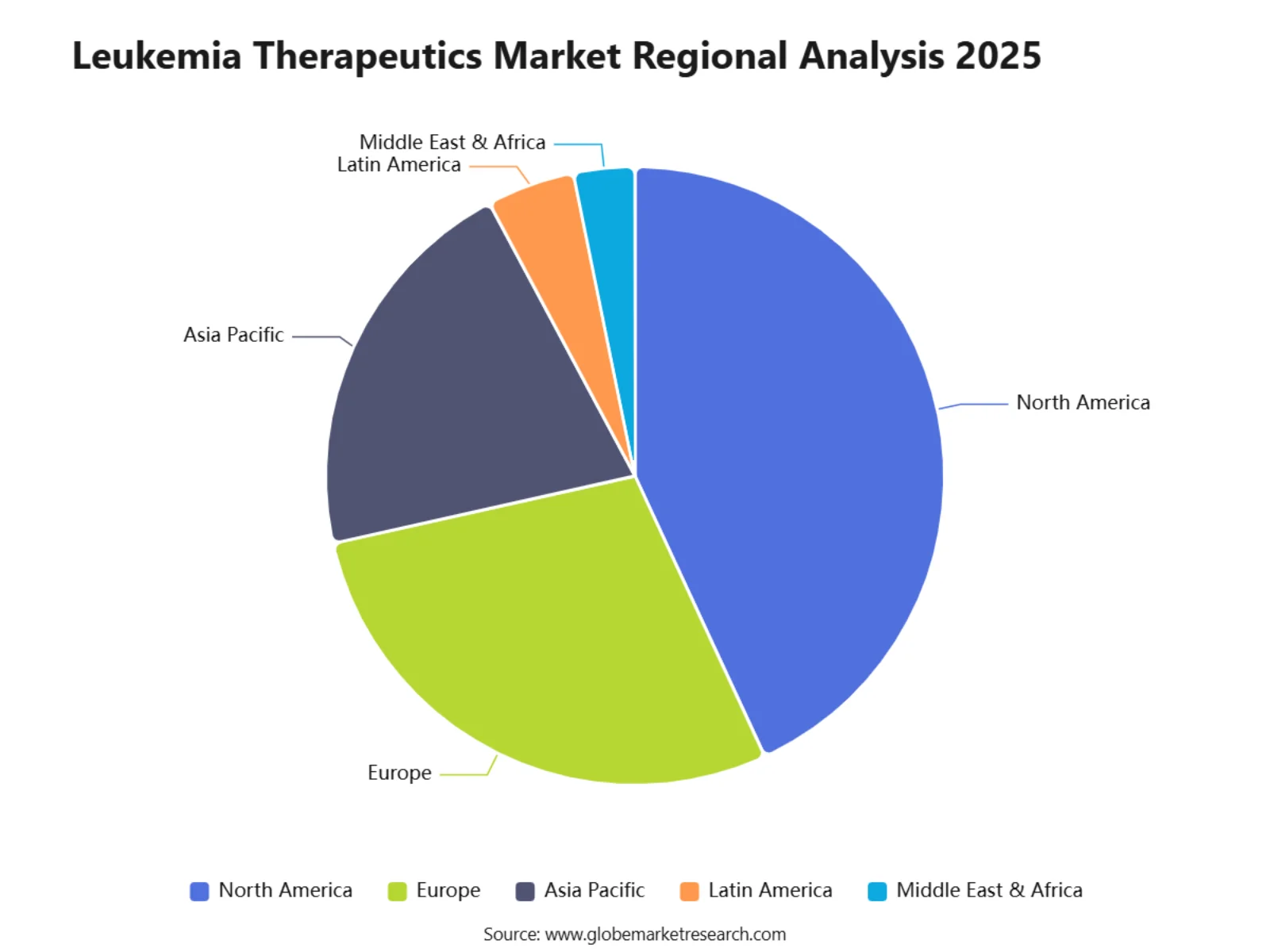
The global Leukemia Therapeutics Market was valued at USD 25.8 billion in 2025 and is projected to reach USD 59.4 billion by 2035, growing at a CAGR of 8.7%. North America led the market with a 43.1% share in 2025, while the U.S. market reached USD 7.6 billion and is expected to grow at a 7.8% CAGR, ssupported by rising diagnosis rates, wider access to advanced therapies, and strong oncology research investment.
Key Takeaways
Targeted therapy accounted for 40.3% share in the leukemia therapeutics market, supported by higher treatment precision, improved patient outcomes, and wider use of mutation-specific therapies.
Chronic lymphocytic leukemia led by leukemia type with 31.1% share, driven by higher disease prevalence among older adults and increasing use of advanced treatment regimens.
Small-molecule drugs accounted for 36.8% share, supported by strong adoption of oral and targeted treatment options across leukemia care.
Injectable mode held 67.2% share by route of administration, driven by the continued use of chemotherapy, monoclonal antibodies, immunotherapies, and hospital-based treatments.
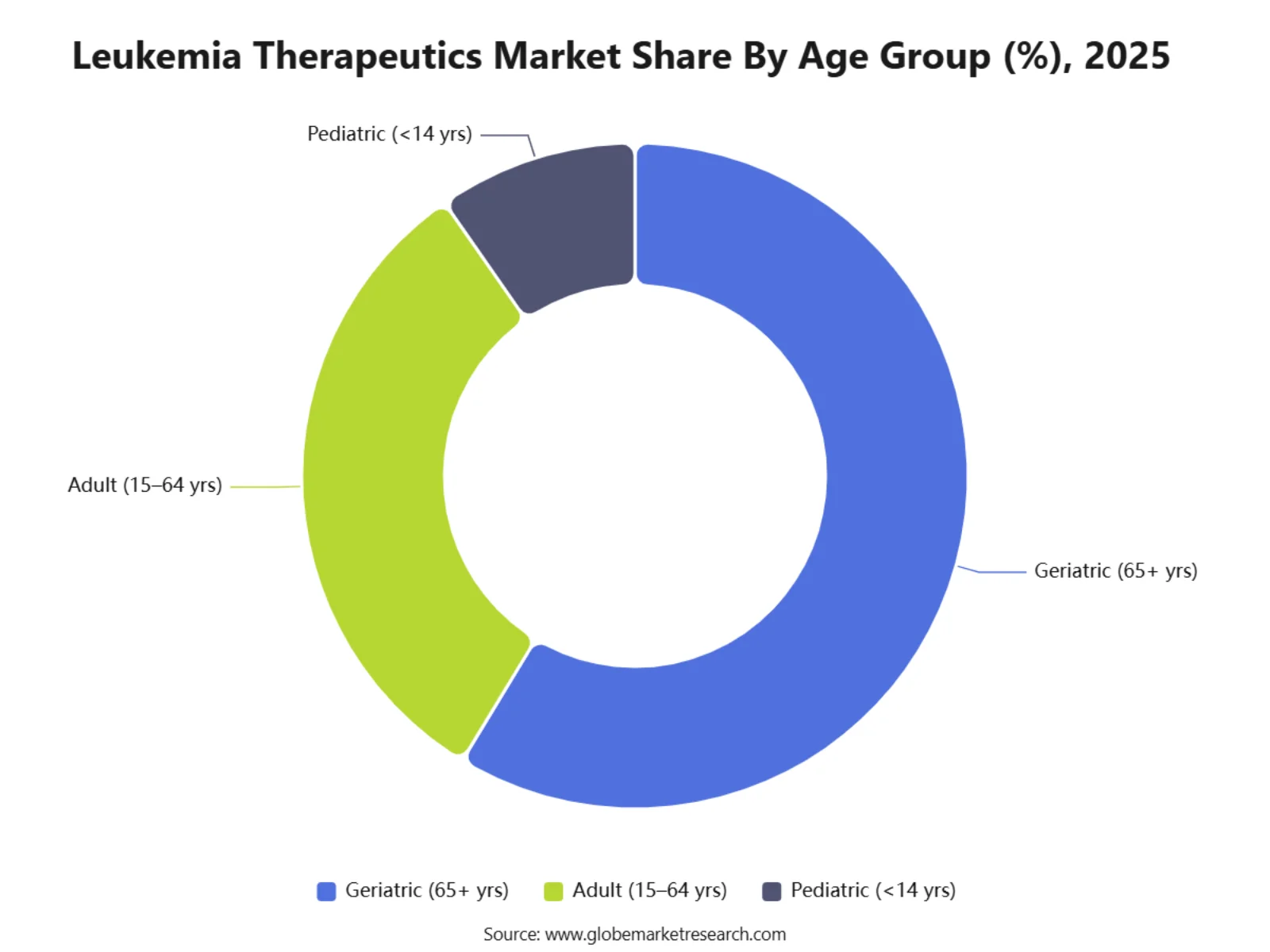
The geriatric age group, 65 years and above, accounted for 58.6% share, as leukemia incidence remains higher among older patients.
North America held 43.10% share of the leukemia therapeutics market, supported by advanced healthcare infrastructure, strong oncology drug access, and high treatment adoption.
The U.S. leukemia therapeutics market was valued at USD 7.6 billion and is projected to grow at a CAGR of 7.8%.
Report Overview
The leukemia therapeutics market covers medicines and treatment methods used to manage acute and chronic forms of leukemia, including acute lymphoblastic leukemia, acute myeloid leukemia, chronic lymphocytic leukemia, and chronic myeloid leukemia. The market includes chemotherapy, targeted therapy, immunotherapy, CAR-T cell therapy, stem cell transplantation, and newer precision medicines that act on specific genetic changes in cancer cells.
The growth of the leukemia therapeutics market can be attributed to the shift from conventional chemotherapy toward targeted and immune-based therapies. Tyrosine kinase inhibitors, monoclonal antibodies, bispecific antibodies, CAR-T cell therapies, and menin inhibitors are improving treatment options for patients with specific disease profiles. This trend is especially important in relapsed or refractory leukemia, where standard treatment options are limited and survival outcomes remain difficult.
Demand for leukemia therapeutics is rising due to the high disease burden across both adult and pediatric populations. In the United States, chronic lymphocytic leukemia is expected to record about 22,760 new cases and 4,350 deaths in 2026, making it one of the most common leukemia types. Acute lymphocytic leukemia is expected to account for about 6,250 new cases and 1,600 deaths in the United States in 2026, with the highest risk seen in children younger than five years.
Report Highlights | Details |
|---|---|
Market Revenue (2025) | USD 25.8 Bn |
Forecast Revenue (2035) | USD 59.4 Bn |
CAGR (2025-2035) | 8.7% |
Base Year for Estimation | 2025 |
Historic Data | 2020-2024 |
Forecast Period | 2025-2035 |
Report Coverage | AI impact Analysis, Revenue projections, company positioning, competitive analysis, growth drivers, and emerging market trends |
Segments Covered | By Treatment Type (Targeted Therapy, Chemotherapy, Immunotherapy, Stem Cell Transplantation, CAR-T Cell Therapy, Other Treatment Types), By Leukemia Type (Acute Lymphoblastic Leukemia, Acute Myeloid Leukemia, Chronic Lymphocytic Leukemia, Chronic Myeloid Leukemia, Other Leukemia Types), By Therapy Modality (Small-Molecule Drugs, Monoclonal Antibodies, CAR-T Cell Therapies, Gene Therapies, Bispecific Antibodies, RNA-based Therapies, Other Modalities), By Route of Administration(Oral, Intravenous, Subcutaneous, Other Routes), By Age Group (Pediatric (<14 yrs), Adult (15–64 yrs), Geriatric (65+ yrs)) |
Regional Analysis | North America – US, Canada; Europe – Germany, France, The UK, Spain, Italy, Russia, Netherlands, Rest of Europe; Asia Pacific – China, Japan, South Korea, India, New Zealand, Singapore, Thailand, Vietnam, Rest of Latin America; Latin America – Brazil, Mexico, Rest of Latin America; Middle East & Africa – South Africa, Saudi Arabia, UAE, Rest of MEA |
Key companies profiled | Amgen Inc., AstraZeneca plc, Bristol-Myers Squibb Co., F. Hoffmann-La Roche Ltd., Incyte Corporation, Johnson & Johnson, Novartis International AG, Pfizer Inc., Sanofi S.A., Teva Pharmaceutical Industries Ltd., Astellas Pharma Inc., Otsuka Holdings Co. Ltd., BeiGene Ltd., Gilead Sciences Inc. (Kite Pharma), AbbVie Inc., Takeda Pharmaceutical Co. Ltd., GlaxoSmithKline plc, Bluebird bio Inc., Jazz Pharmaceuticals plc, Kura Oncology Inc., Ascentage Pharma, Servier Pharmaceuticals, Bayer AG, Sun Pharma Industries Ltd. |
Customization Scope | Tailored insights for specific regions, countries, and market segments can be provided. Additional report customization is available upon request. |
Segment Highlights
By Treatment Type: Targeted Therapy
Targeted therapy accounted for 40.3% share in the Leukemia Therapeutics Market, supported by rising use of precision medicines that act on specific cancer-related pathways. These therapies are widely used in chronic lymphocytic leukemia, chronic myeloid leukemia, and selected acute leukemia cases where genetic markers and disease biology guide treatment decisions.
The segment is gaining importance because targeted drugs can offer more focused treatment than conventional chemotherapy in several leukemia types. The American Cancer Society notes that targeted therapy is commonly used for chronic lymphocytic leukemia and includes medicines that act on proteins involved in cancer cell growth and survival.
By Leukemia Type: Chronic Lymphocytic Leukemia
Chronic lymphocytic leukemia led the Leukemia Therapeutics Market with a 31.1% share. This leadership is supported by the high treatment need among older adults, wider use of targeted medicines, and ongoing treatment advances for relapsed and refractory disease.
CLL remains a major leukemia category in the U.S., with the American Cancer Society estimating about 22,760 new CLL cases and 4,350 deaths in 2026. CLL accounts for about 1 in 3 new leukemia cases in the U.S., and the average age at diagnosis is around 70 years, which supports strong demand for therapies suited to older patients.
By Therapeutic Modality: Small-Molecule Drugs
Small-molecule drugs accounted for 36.8% share in the Leukemia Therapeutics Market, supported by the strong use of oral targeted medicines such as kinase inhibitors, BCL-2 inhibitors, and other pathway-focused treatments. These drugs are important because they can enter cells and act on specific molecular targets involved in leukemia progression.
The segment is also supported by continued regulatory activity in targeted leukemia medicines. In December 2025, the FDA granted traditional approval to pirtobrutinib for adults with relapsed or refractory CLL or small lymphocytic lymphoma after prior treatment with a covalent BTK inhibitor.
By Route of Administration: Injectable Mode
Injectable mode held 67.2% share in the Leukemia Therapeutics Market, supported by the continued use of injectable chemotherapy, monoclonal antibodies, immunotherapy, and hospital-based infusion treatments. This route remains important because many leukemia therapies require controlled administration, dose monitoring, and clinical supervision.
Injectable treatments are especially relevant in acute leukemia care, combination regimens, and cases where patients require intensive therapy. Mayo Clinic notes that many chemotherapy medicines are given through a vein, while some leukemia treatments are available in pill form, showing why injectable care remains central to leukemia treatment pathways.
By Age Group: Geriatric (65+ Years)
The geriatric (65+ years) group accounted for 58.6% share, mainly because leukemia risk increases with age for several major disease types. Older patients often need treatment plans that balance disease control, tolerability, comorbidities, and quality of life.
This segment is strongly linked to chronic leukemia burden. The American Cancer Society states that CLL mainly affects older adults, with an average diagnosis age of around 70 years, while CML has an average diagnosis age of around 66 years. These age patterns support the high share of geriatric patients in leukemia therapeutics demand.
 iThe graph shows projected market growth until 2035 based on CAGR analysis. Actual outcomes may vary depending on changing demand, competition, and economic factors.To gain greater insights - request a sample report PDF
By Regional Analysis: North America
North America held 43.10% share in the Leukemia Therapeutics Market, supported by advanced cancer care infrastructure, early access to new therapies, strong clinical research activity, and high treatment adoption. The region also benefits from established oncology networks, reimbursement systems, and specialist-led treatment pathways.
 iThe graph shows projected market growth until 2035 based on CAGR analysis. Actual outcomes may vary depending on changing demand, competition, and economic factors.To gain greater insights - request a sample report PDF
The U.S. market was valued at USD 7.6 billion and is projected to grow at a CAGR of 7.8%. Growth is supported by rising use of targeted therapy, increasing survival needs, and the large diagnosed patient base across CLL, AML, ALL, and CML. The American Cancer Society estimated 6,250 new ALL cases and 9,650 new CML cases in the U.S. for 2026, adding to the country’s overall leukemia treatment demand.
Market Segmentation
By Treatment Type
Chemotherapy
Immunotherapy
Targeted Therapy
CAR-T Cell Therapy
Gene Therapy
Stem Cell Transplantation
Other Treatment Types
By Leukemia Type
Acute Lymphoblastic Leukemia
Acute Myeloid Leukemia
Chronic Lymphocytic Leukemia
Chronic Myeloid Leukemia
Other Leukemia Types
By Therapy Modality
Small-Molecule Drugs
Monoclonal Antibodies
CAR-T Cell Therapies
Gene Therapies
Bispecific Antibodies
RNA-based Therapies
Other Modalities
By Route of Administration
Oral
Intravenous
Subcutaneous
Other Routes
By Age Group
Pediatric (<14 yrs)
Adult (15–64 yrs)
Geriatric (65+ yrs)
By Region
North America
Europe
Asia Pacific
Latin America
Market Dynamics
Drivers Impact Analysis
Impact Factor | Estimated CAGR Impact | Regional Relevance | Market Impact |
|---|---|---|---|
Rising leukemia diagnosis rates | +2.3% | North America, Europe, Asia Pacific | Increases treatment demand. |
Growth in targeted therapy adoption | +2.1% | U.S., Europe, Japan, China | Improves treatment precision. |
Increasing use of immunotherapy | +1.8% | North America, Europe, developed Asia | Supports advanced care options. |
Strong oncology research pipeline | +1.6% | U.S., Germany, UK, Japan, China | Expands new drug availability. |
Rising healthcare spending | +1.4% | U.S., Europe, China, India, GCC | Improves treatment access. |
Restraints Impact Analysis
Impact Factor | Estimated CAGR Impact | Regional Relevance | Market Impact |
|---|---|---|---|
High treatment cost | -1.5% | Global, especially emerging markets | Limits patient access. |
Adverse effects of therapies | -1.1% | Global | Affects treatment adherence. |
Limited access to advanced care | -1.3% | Africa, Latin America, rural Asia Pacific | Restricts therapy adoption. |
Complex reimbursement process | -1.0% | U.S., Europe, Japan | Delays treatment access. |
Drug resistance concerns | -1.2% | Global | Reduces long-term efficacy. |
Opportunities Impact Analysis
Impact Factor | Estimated CAGR Impact | Regional Relevance | Market Impact |
|---|---|---|---|
Expansion of precision medicine | +2.2% | U.S., Europe, Japan, China | Supports personalized treatment. |
Growth in CAR-T cell therapy | +1.9% | North America, Europe, China | Creates high-value therapy demand. |
Rising clinical trial activity | +1.7% | U.S., Europe, Asia Pacific | Supports pipeline development. |
Emerging market treatment expansion | +1.5% | India, China, Brazil, GCC | Opens new patient access. |
Development of combination therapies | +1.6% | Global | Improves treatment outcomes. |
Challenges Impact Analysis
Impact Factor | Estimated CAGR Impact | Regional Relevance | Market Impact |
|---|---|---|---|
Therapy resistance and relapse | -1.4% | Global | Creates treatment complexity. |
Low diagnosis rates in poor regions | -1.1% | Africa, South Asia, Latin America | Limits treated patient pool. |
Manufacturing complexity for cell therapies | -1.0% | U.S., Europe, China | Slows therapy scalability. |
Strict regulatory requirements | -0.9% | U.S., Europe, Japan | Extends approval timelines. |
Shortage of oncology specialists | -0.8% | Emerging markets | Limits advanced treatment delivery. |
Recent Developments
May 2026 – Taiho Oncology received U.S. FDA approval for Inqovi plus venetoclax for newly diagnosed acute myeloid leukemia, or AML, in adults aged 75 years and above or patients not eligible for intensive chemotherapy. The approval was based on the ASTX727-07 trial with 101 patients. This supports demand for oral AML regimens that reduce frequent clinic visits.
May 2026 – AbbVie received U.S. FDA approval for pivekimab sunirine-pvzy for blastic plasmacytoid dendritic cell neoplasm, a rare aggressive blood cancer. In trials, 23 of 33 untreated patients and 8 of 51 relapsed or refractory patients achieved full remission. The approval strengthens AbbVie’s hematology position and expands treatment options for patients with limited alternatives.
March 2026 – Merck agreed to acquire Terns Pharmaceuticals for about USD 6.7 billion. The deal adds TERN-701, an investigational oral allosteric BCR::ABL1 tyrosine kinase inhibitor for chronic myeloid leukemia, or CML. The transaction shows strong M&A interest in targeted hematology pipelines and next-generation leukemia therapies.
Competitive Landscape
The market is characterized by intense competition among established players and emerging companies. Strategic partnerships, mergers and acquisitions, and product innovation are key strategies employed by market participants.
Key Market Players
Amgen Inc.
AstraZeneca plc
Bristol-Myers Squibb Co.
F. Hoffmann-La Roche Ltd.
Incyte Corporation
Johnson & Johnson
Teva Pharmaceutical Industries Ltd.
Astellas Pharma Inc.
Novartis International AG
Pfizer Inc.
Sanofi S.A.
Otsuka Holdings Co., Ltd.
Others
Meet the Team
This report was prepared by our expert analysts with deep industry knowledge and research experience.
Kevin is a market research analyst with expertise in industry analysis, market sizing, competitive benchmarking, and growth opportunity assessment. Her work focuses on delivering clear, data-backed insights that help businesses understand market trends, customer demand, emerging technologies, and investment potential across global industries.
Suraj is a seasoned Senior Management Consultant with over 7 years of experience in market research, business strategy, and consulting. He has worked with Fortune 500 companies as well as emerging startups, supporting clients in cross-border expansion, market entry strategies, and growth planning. He has played a key role in delivering strategic viewpoints and actionable insights across various client projects. His expertise includes demand analysis, competitive analysis, market opportunity assessment, channel partner identification, and business expansion strategy. His analytical approach and industry understanding help clients make informed decisions and enter new markets with greater confidence.
Frequently Asked Questions
Related Reports
More in Healthcare and Pharmaceuticals
Biohacking Market to Exceed USD 231.3 Billion by 2035
Global Biohacking Market Size, Share Analysis Report By Product Type (Wearable Devices, Smart Implants, Gene-Editing Kits, Nootropics & Supplements, Sensors & Biomonitoring Patches, Others), By Biohacking Type (Nutrigenomics, DIY Biology, Grinder, and Others), By End User (Consumers, Healthcare Facilities, and Others), By Regional Insights, Business plan and Project Report, Investment Opportunities, Profitability, Industry Trends, Leading Companies and Growth Forecasts by 2025-2035
Telemedicine Market to Exceed USD 981.6 Billion by 2035
Global Telemedicine Market Size, Share Analysis Report By Modality (Synchronous, Asynchronous, Remote Patient Monitoring), By Component (Software Platforms, Hardware & Peripherals, Services), By End User (Healthcare Providers, Payers & Employers, Patients / Home Users, Government Agencies & NGOs), By Regional Insights, Business plan and Project Report, Investment Opportunities, Profitability, Industry Trends, Leading Companies and Growth Forecasts by 2025-2035
Helicobacter Pylori Diagnostics Market to hit 4.6 Bn by 2035
Global Helicobacter Pylori Diagnostics Market Size and Trade Analysis Report By Product Type (Instruments, Services, and Reagents), By Application (Immunoassays, Molecular Diagnostics, and Point-of-Care (POC)), By End User (Hospitals, Diagnostic Laboratories, and Clinics), By Regional Insights, Leading Companies and Growth Forecasts by 2025-2035