

Revenue, 2025
$0.1Bn
Forecast, 2035
$5.7Bn
CAGR, 2025-2035
49.9%
Report Coverage
Italy
Market Size and Forecast
The Italy Agentic AI Market was valued at USD 0.1 billion in 2025 and is projected to reach USD 5.7 billion by 2035, growing at a CAGR of 49.9% during the forecast period. The strong growth outlook is supported by rising enterprise interest in autonomous AI systems that can plan tasks, take decisions, manage workflows, and support business functions with limited human input. Demand is increasing across banking, insurance, manufacturing, healthcare, retail, telecom, and public services as organizations look for faster operations, lower manual workload, and better digital service delivery.
The market is still at an early stage in Italy, but the growth potential is high because AI adoption is moving from basic analytics and chatbots toward task-oriented digital agents. These systems are being used for customer support, fraud monitoring, document processing, sales assistance, supply chain coordination, software development, and internal productivity. In 2025, only 8.2% of Italian enterprises had adopted AI, which shows that the country still has a large untapped base for future deployment. This low starting point creates strong room for agentic AI expansion as companies modernize their technology systems.
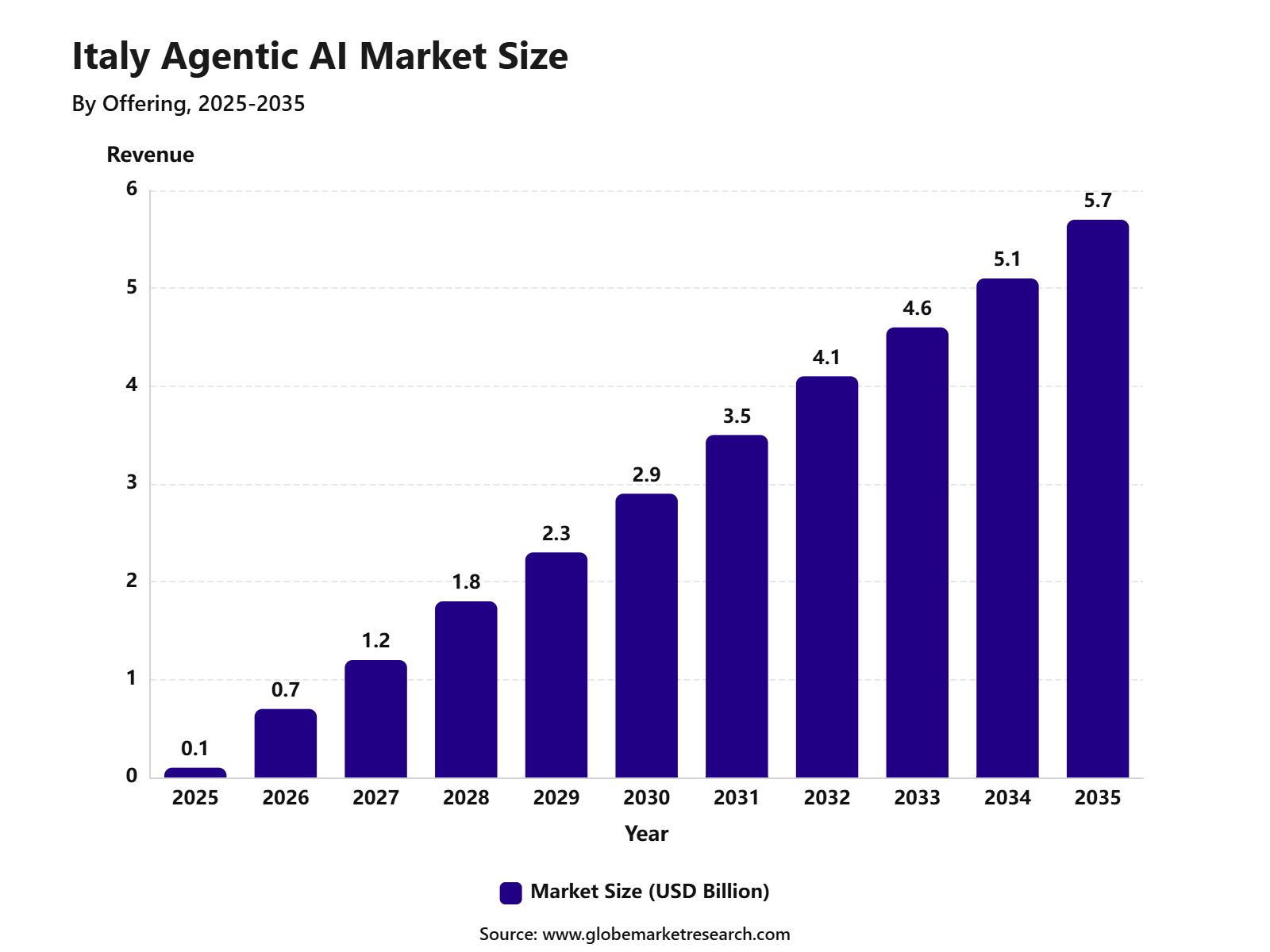 iThe graph shows projected market growth until 2035 based on CAGR analysis. Actual outcomes may vary depending on changing demand, competition, and economic factors.To gain greater insights - request a sample report PDF
Key Insight Summary
Solutions led the market by offering with 69.3% share, supported by strong adoption of AI platforms, automation tools, and enterprise-grade applications.
Cloud-based deployment dominated with 68.6% share, driven by scalability, faster implementation, and reduced infrastructure costs.
Multi-agent systems accounted for 56.1% share, supported by their ability to handle complex workflows and coordinate tasks across functions.
Generative AI and LLM-based agents led the technology segment with 44.8% share, driven by content generation, coding, customer support, and business productivity applications.
Operations and process automation held 27.1% share by function, supported by demand for workflow optimization, decision support, and efficiency improvements.
Large enterprises led by size with 71.1% share, reflecting higher budgets, digital readiness, and strategic adoption of agentic AI.
BFSI dominated end-use with 35.8% share, supported by growing use of AI agents in fraud detection, risk assessment, customer service, and operational automation.
Italy Agentic AI Market Overview
The Italy Agentic AI market refers to the use of AI systems that can plan tasks, make decisions, take actions, and complete workflows with limited human input. These systems are different from basic chatbots because they can connect with business software, read data, trigger actions, support employees, and improve decision-making across departments. In Italy, the market is still at an early stage, but interest is increasing as companies look for practical AI tools to reduce manual work, improve service quality, and raise productivity.
Italy’s wider AI adoption is improving, but it remains below the European average. In 2025, 16.4% of Italian firms with at least 10 employees used some form of AI, compared with 8.2% in 2024 and 5.0% in 2023. Large enterprises are moving faster, with AI usage rising to 53.1% in firms with at least 250 employees , while smaller firms reached 15.7% . This gap shows that agentic AI demand is expected to grow first in large enterprises, banking, telecom, manufacturing, IT services, and business process automation.
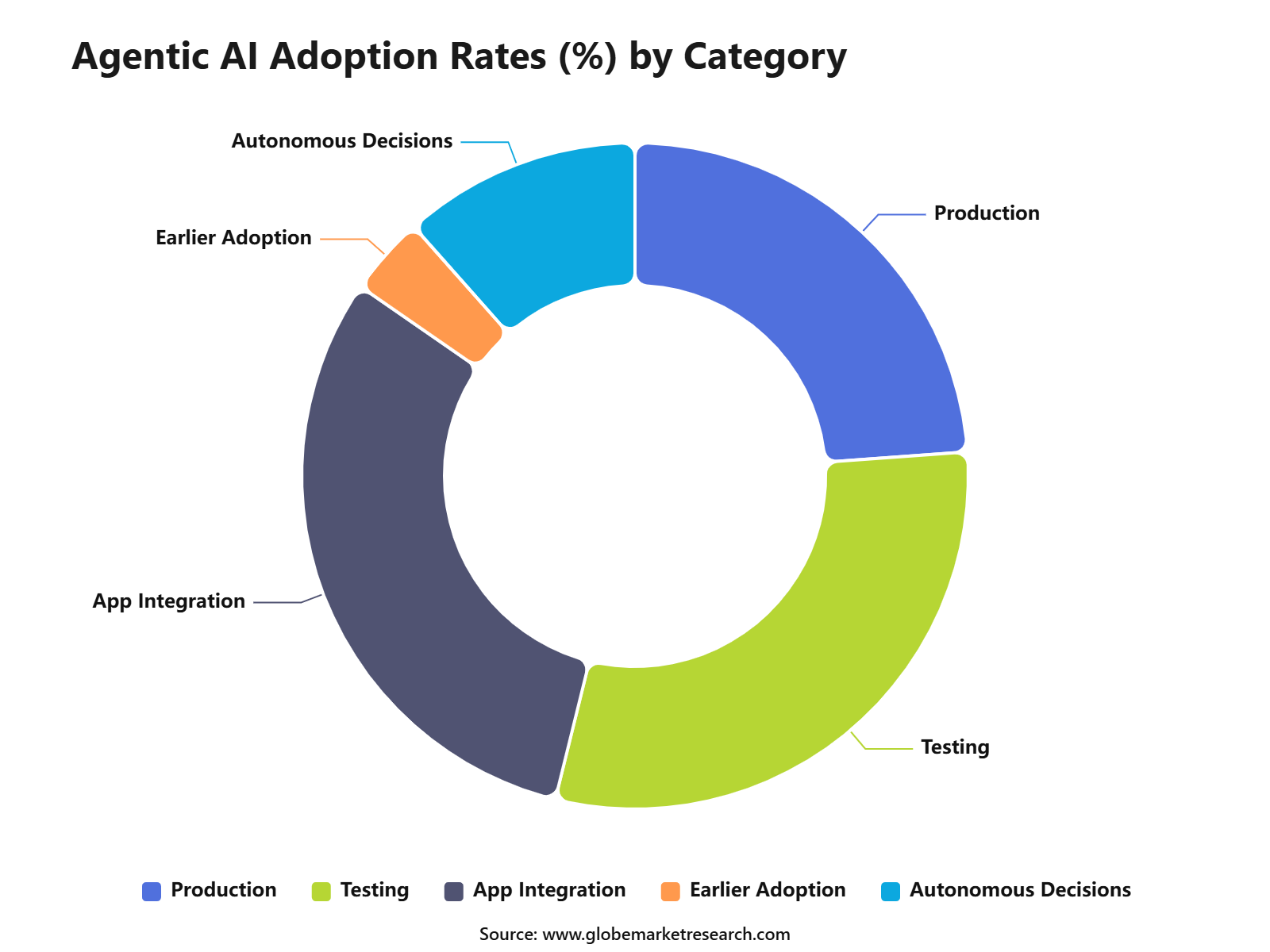 iThe graph shows projected market growth until 2035 based on CAGR analysis. Actual outcomes may vary depending on changing demand, competition, and economic factors.To gain greater insights - request a sample report PDF
Government support is also strengthening the market environment. Italy announced an AI investment fund with an initial endowment of EUR 1 billion , backed by CDP Venture Capital, with the potential to attract another EUR 2 billion from private investors. The government also approved a bill to establish national rules for AI use, promote AI projects and startups, and support a national AI strategy based on human oversight and responsible adoption.
According to Microsoft, Agentic AI adoption in Italy is still lower than broader generative AI adoption. In Italy, only 2.3% of companies reported using agentic AI technologies, compared with a 4.2% European average. However, business benefits linked with AI adoption are clear, as companies reported efficiency and productivity gains at 64%, customer support benefits at 39% , and process optimization benefits at 36% . These benefits are expected to support gradual adoption of AI agents across finance, customer service, operations, software development, and back-office functions.
The strongest demand is expected from sectors where workflows are data-heavy and process-driven. Italian AI uptake was highest in IT services at 53% , video production at 49.5% , and telecommunications at 37.3% . Common AI uses included text data extraction at 70.8% , generative AI for language and images at 59.1% , and speech-to-text technologies at 41.3% . These use cases provide a strong base for agentic AI because autonomous agents depend on language processing, data extraction, workflow automation, and decision support.
Segment Insights
By Offering
Solutions led the Italy Agentic AI Market with 69.3% share, supported by rising enterprise demand for ready-to-deploy AI tools that can manage workflows, automate decisions, and connect with existing business systems. Italian firms are still in the early adoption stage, but usage is rising as companies move from basic AI experiments to structured applications across operations, finance, customer service, and compliance.
The shift is being supported by Italy’s broader AI adoption base, as business AI use increased to 16.4% in 2025 from 8.2% in 2024, showing faster movement from basic digital tools to AI-enabled enterprise applications. The dominance of solutions is also linked to the need for faster implementation and lower development effort. In Italy, firms are mainly applying AI for practical work, with text data extraction used by 70.8% of AI-adopting companies, which directly supports demand for packaged agentic AI solutions in document-heavy functions.
By Deployment Mode
Cloud-based deployment accounted for 68.6% share, as enterprises prefer flexible platforms that can scale with data volume, users, and AI workload intensity. Italy’s 2025 Digital Decade review noted strong progress in digital infrastructure and public digital services, which supports wider enterprise use of cloud-based AI systems.
Cloud deployment is important because agentic AI needs continuous model access, secure data pipelines, API connections, and frequent updates. Across the EU, 19.95% of enterprises used AI technologies in 2025, showing that cloud-connected AI adoption is becoming more common across business environments, especially where automation and analytics are used together.
By Agent System
Multi-agent systems held 56.1% share, as Italian enterprises are increasingly looking beyond single-task AI tools toward coordinated agent networks. These systems allow multiple AI agents to work together across functions such as customer support, compliance checks, document processing, fraud monitoring, and internal reporting. This structure is well suited for large organizations where work moves across many departments. The growth of multi-agent systems is supported by the need for higher process accuracy and better task coordination.
In Italy, regulated industries such as finance, healthcare, manufacturing, and public services require AI systems that can divide responsibilities, maintain audit trails, and support human review. The segment is gaining traction as enterprises move beyond single-purpose assistants. In the Italian financial sector, an OECD survey found that 39% of respondents were already using AI in everyday operations, creating a stronger base for multi-agent systems that can support compliance, risk checks, reporting, and customer-facing tasks.
By Technology
Generative AI and LLM-based agents led the technology segment with 44.8% share, driven by their ability to understand language, summarize documents, draft responses, extract information, and support complex decision workflows. Italian enterprise AI adoption remains developing, but generative AI has become one of the most visible use cases because it can be applied quickly across office work, customer communication, legal review, and knowledge management.
Reuters reported that common AI applications among Italian firms included text data extraction, generative AI for language and images, and speech-to-text tools. The adoption of LLM-based agents is being shaped by the need to handle emails, contracts, reports, service tickets, customer queries, and internal knowledge search. Among Italian-speaking adults, a 2025 empirical study based on 1,906 respondents found wide use of generative AI for both work and personal tasks, showing that familiarity with conversational AI is also rising outside enterprise settings.
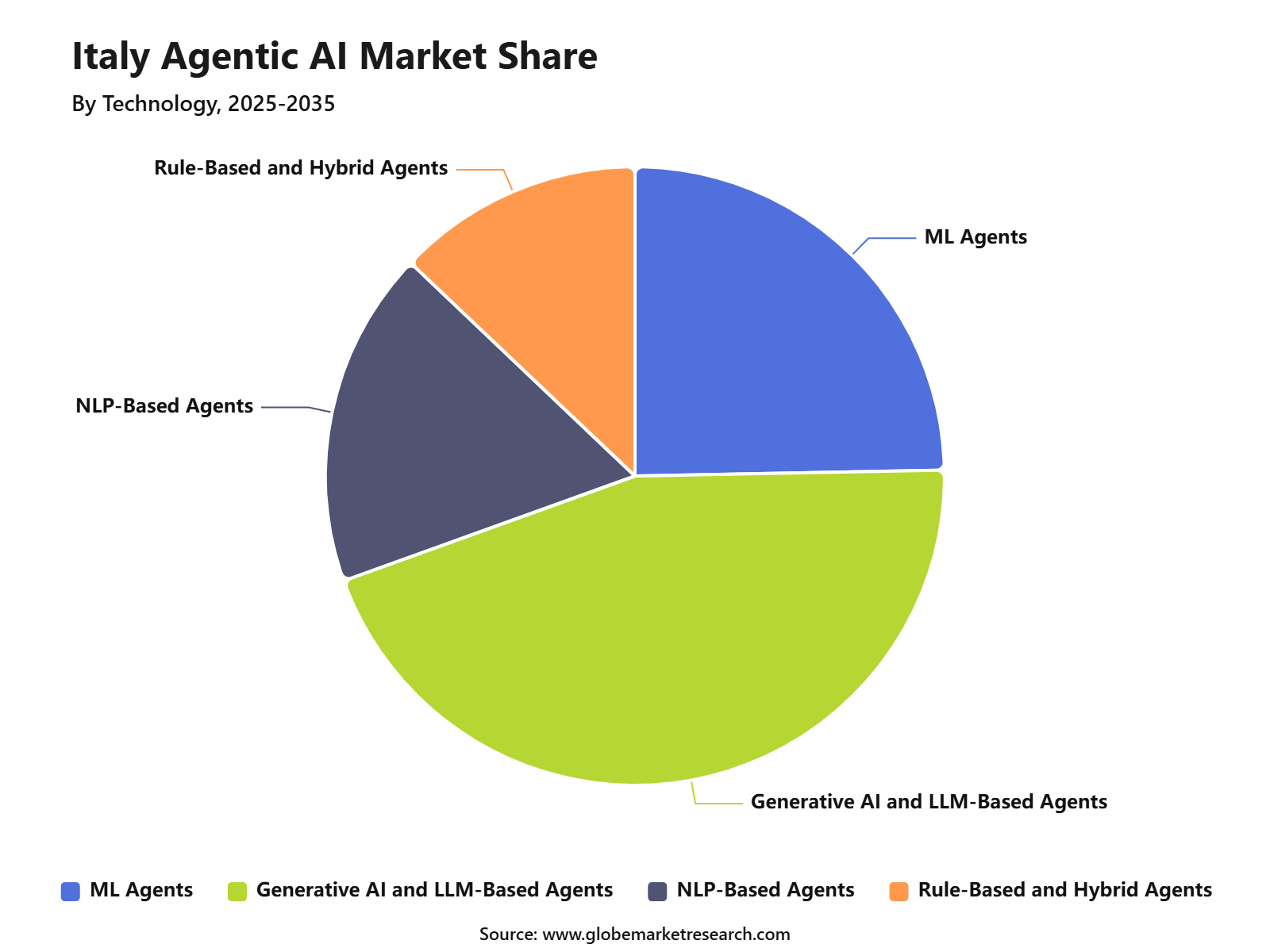 iThe graph shows projected market growth until 2035 based on CAGR analysis. Actual outcomes may vary depending on changing demand, competition, and economic factors.To gain greater insights - request a sample report PDF
By Function
Operations and process automation accounted for 27.1% share, as enterprises in Italy are using agentic AI to reduce manual work, improve response speed, and standardize repetitive business tasks. AI agents can support invoice processing, claims handling, customer onboarding, supply chain tracking, service desk workflows, and compliance documentation. This makes operations one of the most practical adoption areas because benefits can be measured through time savings and error reduction.
Agentic AI is useful where repetitive decisions must be made across large volumes of data. Human oversight remains important, especially after Italy’s AI law emphasized transparent, secure, and human-centered AI use across sensitive sectors. In Italy, lack of skills was cited as a barrier by 58.6% of firms not adopting AI, which increases the value of agentic systems that can simplify work, reduce repetitive effort, and support employees with guided automation.
By Enterprise Size
Large enterprises accounted for 71.1% share, supported by stronger technology budgets, larger data assets, and better readiness for AI governance. In the EU, 55.03% of large enterprises used AI technologies in 2025, showing that large firms remain the strongest adopters because they have the scale and internal systems needed for advanced automation.
Large enterprises are also more likely to have cloud systems, cybersecurity controls, compliance teams, and data governance frameworks. These capabilities are essential for agentic AI because autonomous workflows need reliable data access, controlled permissions, and clear accountability. As a result, large companies are expected to remain the main adopters in the near term, while SMEs will follow as tools become simpler and more affordable.
By End Use
BFSI led the Italy Agentic AI Market with 35.8% share, driven by use cases in fraud monitoring, credit review, claims handling, risk assessment, customer support, and regulatory reporting. The OECD reported that insurance showed the highest AI deployment in Italian financial markets, with 70% of respondents using AI, followed by banking at 59% .
Adoption in BFSI is being driven by practical use cases such as loan assessment support, customer query handling, transaction monitoring, insurance claims review, and regulatory reporting. AI tools based on machine learning can support personalized financial products and improve service efficiency when used with proper controls. This makes BFSI one of the strongest areas for agentic AI in Italy, especially where automation can improve speed while keeping human review in sensitive decisions.
Regional Impact Analysis
Impact Factor | Estimated CAGR Impact | Regional Relevance | Market Impact |
|---|---|---|---|
Northern Italy enterprise AI adoption | +13.0% | Milan, Turin, Bologna | Leads business adoption. |
Central Italy public and services demand | +10.6% | Rome and surrounding regions | Supports institutional use. |
Industrial automation in manufacturing hubs | +10.2% | Lombardy, Emilia-Romagna, Veneto | Drives process automation. |
Southern Italy digital transformation potential | +7.8% | Naples, Bari, Palermo | Builds early demand. |
Italy-wide cloud AI expansion | +11.4% | National market | Supports broad deployment. |
Drivers Impact Analysis
Impact Factor | Estimated CAGR Impact | Regional Relevance | Market Impact |
|---|---|---|---|
Rising enterprise automation demand | +12.4% | Italy, especially Milan, Rome, Turin | Drives workflow automation. |
Growing adoption of generative AI and LLMs | +11.6% | Italy, large enterprises, BFSI, IT services | Supports intelligent agents. |
Expansion of cloud-based AI platforms | +10.8% | Italy, enterprise and public sector users | Enables scalable deployment. |
Increasing demand for process automation | +10.2% | BFSI, manufacturing, retail, telecom | Reduces manual work. |
Rising digital transformation spending | +9.5% | Italy, large and mid-sized firms | Accelerates AI adoption. |
Restraints Impact Analysis
Impact Factor | Estimated CAGR Impact | Regional Relevance | Market Impact |
|---|---|---|---|
High implementation cost | -5.8% | SMEs and cost-sensitive firms | Limits early adoption. |
Data privacy and security concerns | -5.4% | Italy, regulated industries | Raises compliance pressure. |
Lack of skilled AI professionals | -4.8% | Italy, enterprise technology teams | Slows deployment. |
Integration with legacy systems | -4.5% | BFSI, manufacturing, public sector | Delays implementation. |
Limited trust in autonomous AI decisions | -4.1% | Regulated and risk-sensitive sectors | Restricts wider use. |
Opportunities Impact Analysis
Impact Factor | Estimated CAGR Impact | Regional Relevance | Market Impact |
|---|---|---|---|
Growth in multi-agent systems | +12.2% | Italy, enterprise automation users | Enables complex workflows. |
Expansion in BFSI automation | +11.4% | Italy banking, insurance, fintech | Improves service efficiency. |
AI agents for operations and process automation | +10.9% | Manufacturing, logistics, retail | Optimizes business tasks. |
Adoption by large enterprises | +10.5% | Milan, Rome, Turin, Bologna | Drives premium demand. |
Development of industry-specific AI agents | +9.8% | BFSI, healthcare, manufacturing, telecom | Supports tailored use cases. |
Challenges Impact Analysis
Impact Factor | Estimated CAGR Impact | Regional Relevance | Market Impact |
|---|---|---|---|
AI governance complexity | -5.2% | Italy, EU-regulated market | Increases compliance needs. |
Output accuracy and reliability issues | -4.9% | Global and Italy enterprise users | Reduces user confidence. |
Cybersecurity risk from autonomous agents | -4.6% | BFSI, healthcare, public sector | Raises security concerns. |
Vendor dependency and lock-in | -4.0% | Enterprise cloud users | Limits platform flexibility. |
Change management resistance | -3.8% | Traditional business sectors | Slows adoption speed. |
Key Market Segments
By Offering
Solutions
Services
By Deployment Mode
Cloud-Based
On-Premise
By Agent System
Multi-Agent Systems
Single-Agent Systems
By Technology
Generative AI and LLM-Based Agents
Machine Learning Agents
NLP-Based Agents
Rule-Based and Hybrid Agents
By Function
Operations and Process Automation
Customer Service and Support
Sales and Marketing Automation
Risk, Compliance, and Fraud Management
IT, Cybersecurity, and Others
By Enterprise Size
Large Enterprises
SMEs
By End Use
BFSI
Manufacturing
IT and Telecommunications
Healthcare and Life Sciences
Retail and E-Commerce
Public Sector
Others
By Country Scope
Italy
Market Trend Analysis
Impact Factor | Estimated CAGR Impact | Regional Relevance | Market Impact |
|---|---|---|---|
Cloud-based agent deployment | +12.0% | Italy, enterprise and SMEs | Supports faster rollout. |
Generative AI and LLM-based agents | +11.7% | Italy, BFSI, IT, services | Powers advanced automation. |
Multi-agent system adoption | +10.9% | Large enterprises | Handles complex tasks. |
AI agents for operations automation | +10.4% | Manufacturing, BFSI, retail | Improves process efficiency. |
Human-in-the-loop AI governance | +8.9% | Regulated sectors | Improves control and trust. |
Demand Analysis
Impact Factor | Estimated CAGR Impact | Regional Relevance | Market Impact |
|---|---|---|---|
Demand for business productivity tools | +12.1% | Italy, enterprise users | Reduces repetitive tasks. |
Demand for operations automation | +11.3% | Manufacturing, logistics, BFSI | Improves process speed. |
Demand from BFSI sector | +10.8% | Italy banking and insurance | Drives high-value adoption. |
Demand for customer support automation | +9.7% | Retail, telecom, banking | Improves service handling. |
Demand for real-time decision support | +9.2% | Enterprise and public sector | Strengthens business decisions. |
Recent Development News
May 2026 – UniCredit expanded its AI-driven M&A platform, DealSync, to improve deal sourcing for smaller and mid-sized companies. The platform generated about 4,500 deal leads and completed 2 transactions, supporting wider use of AI agents in banking, corporate finance, and advisory workflows.
October 2025 – Italy’s national AI law came into force, making Italy one of the first EU countries to adopt a comprehensive domestic AI framework aligned with the EU AI Act. The law focuses on human oversight, transparency, cybersecurity, privacy, healthcare, work, education, justice, and child protection.
Report Scope
Report Highlights | Details |
|---|---|
Market Revenue (2025) | USD 0.1 Bn |
Forecast Revenue (2035) | USD 5.7 Bn |
CAGR (2025-2035) | 49.9% |
Base Year for Estimation | 2025 |
Historic Data | 2020-2024 |
Forecast Period | 2025-2035 |
Report Coverage | AI impact analysis, Revenue projections, company positioning, competitive analysis, growth drivers, and emerging market trends |
Segments Covered | By Offering (Solutions, Services), By Deployment Mode (Cloud-Based, On-Premise), By Agent System (Multi-Agent Systems, Single-Agent Systems), By Technology (Generative AI and LLM-Based Agents, ML Agents, NLP-Based Agents, Rule-Based and Hybrid Agents), By Function (Operations and Process Automation, Customer Service and Support, Sales and Marketing Automation, Risk, Compliance, and Fraud Management, IT, Cybersecurity, and Others), By Enterprise Size (Large Enterprises, SMEs), By End Use (BFSI, Manufacturing, IT and Telecommunications, Healthcare and Life Sciences, Retail and E-Commerce, Public Sector, Others) |
Key companies profiled | OpenAI, Google, Microsoft, IBM, Amazon, Anthropic, Cohere, AI21 Labs, Hugging Face, Salesforce, Oracle, SAP, NVIDIA, Meta, Databricks and More |
Customization Scope | Tailored insights for specific regions, countries, and market segments can be provided. Additional report customization is available upon request. |
Competitive Landscape
The market is characterized by intense competition among established players and emerging companies. Strategic partnerships, mergers and acquisitions, and product innovation are key strategies employed by market participants.
Key Market Players
OpenAI
Microsoft
IBM
Amazon
Anthropic
Cohere
AI21 Labs
Salesforce
Oracle
NVIDIA
Meta
Databricks
Other Key Players
Meet the Team
This report was prepared by our expert analysts with deep industry knowledge and research experience.
Manoj H. brings more than 7 years of professional experience in market research, business intelligence, and industry-focused analysis. His research background covers detailed market assessment, competitive benchmarking, consumer and industry trend tracking, and strategic opportunity evaluation across multiple global sectors. Over the years, Manoj has worked on a wide range of research assignments involving market estimation, company analysis, value chain assessment, regional outlook, and growth opportunity mapping. His expertise lies in converting complex business data into clear, useful, and decision-ready insights for companies, investors, consultants, and industry stakeholders.
Sayali brings more than 5 years of experience to Globe Market Research, supporting the accuracy, clarity, and relevance of research content across multiple industries. She reviews market data, segment analysis, competitive insights, and industry trends to ensure each report meets strong quality standards and provides practical value to business decision-makers. Her expertise spans healthcare, information technology, consumer goods, and diverse cross-industry domains. With a strong focus on data reliability, structured analysis, and clear presentation, Sayali helps ensure that each research output delivers well-reviewed insights for clients, investors, consultants, and industry stakeholders.
Frequently Asked Questions
Related Reports
More in Information and Technology
5G RAN Market Size to hit USD 108.5 billion by 2035
Global 5G RAN Market Size, Go-to-Market and Sales Strategy Analysis By Component (Hardware, Software, Services), By Architecture Type (Traditional RAN, Open RAN), By Deployment (Public Networks, Private Networks), By End Use (Telecom Operators, Enterprise and Industrial Users), By Regional Insights, Business plan and Project Report, Investment Opportunities, Profitability, Industry Trends, Leading Companies and Growth Forecasts By 2025-2035
Online Dating Market Size to hit USD 29.5 Bn by 2035
Global Online Dating Market Size, Go-to-Market Strategy Analysis By Type (Paying Online Dating, Non-Paying Online Dating), By Revenue Model (Subscription, Advertising-Supported, Other Model), By Platform (Web Portals, Applications), By Age Group (Adult, Baby Boomer, Generation X, Generation Z, Millennials), By Regional Insights, Business plan and Project Report, Investment Opportunities, Profitability, Industry Trends, Leading Companies and Growth Forecasts By 2025-2035
AI In Interior Design Market Size to hit USD 37.7 billion by 2035
Global AI In Interior Design Market Size, Go-to-Market Strategy Analysis By Component (Solution, Service), By Deployment (Cloud, On-Premises), By User Type (Homeowners, Real Estate Developers, Interior Designers, Architects, Corporate Clients), By Design Style (Traditional, Modern, Contemporary, Minimalist, Eclectic), By Technology Integration (3D Visualization Tools, Virtual Reality Solutions, Augmented Reality Applications, CAD Software, Machine Learning Algorithms), By Application (Residential Design, Commercial Design, Hospitality Design, Retail Spaces, Office Spaces), By Pricing Strategy (Subscription-Based, Freemium Model, Pay-Per-Use, One-Time License, Enterprise Licensing, Project-Based Pricing), By Regional Insights, Business plan and Project Report, Investment Opportunities, Profitability, Industry Trends, Leading Companies and Growth Forecasts By 2025-2035
Facility Management Market Size to hit USD 4.3 Trillion by 2035
Global Facility Management Market Size, Go-to-Market Strategy Analysis By Service Type (Hard Services, Soft Services), By Offering (In-House, Outsourced), By End User (Commercial, Industrial, Government and Public Sector, Residential, Institutional, Others), By Service Provider (Single Service Providers, Integrated Facility Management Providers, Bundled Service Providers), By Contract Type (Annual Contracts, Flexible Contracts, Performance-Based Contracts), By Regional Insights, Business plan and Project Report, Investment Opportunities, Profitability, Industry Trends, Leading Companies and Growth Forecasts By 2025-2035