

Revenue, 2025
$109.3 Bn
Forecast, 2035
$1,651.8 Bn
CAGR, 2025-2035
31.2%
Report Coverage
Global
Market Size and Forecast
The global Generative AI Market was valued at USD 109.3 billion in 2025 and is projected to reach USD 1,651.8 Bn by 2035, growing at a CAGR of 31.2%. North America led the market with a 49.3% share in 2025, while the U.S. market reached USD 11.6 billion and is expected to grow at a 38.6% CAGR, supported by strong enterprise AI adoption, advanced cloud infrastructure, rising LLM investment, and wider use across software, healthcare, finance, and marketing.
According to Stanford AI Index 2026, generative AI remained one of the strongest investment areas, with funding growing by more than 200% and accounting for nearly half of all private AI investment. In addition, wider AI adoption across organizations continued to expand, as 88% of organizations reported using AI in at least one business function, while generative AI usage reached 79% in 2025 and continued to influence enterprise technology budgets in 2026.
U.S. private AI investment reached USD 285.9 billion in 2025, more than 23 times the level recorded in China, which highlights the strong funding base supporting North American leadership in generative AI. Demand is especially high across software development, media and entertainment, BFSI, healthcare, retail, education, and marketing, where generative AI is being used to improve productivity, reduce content creation time, personalize digital services, and support faster decision-making.
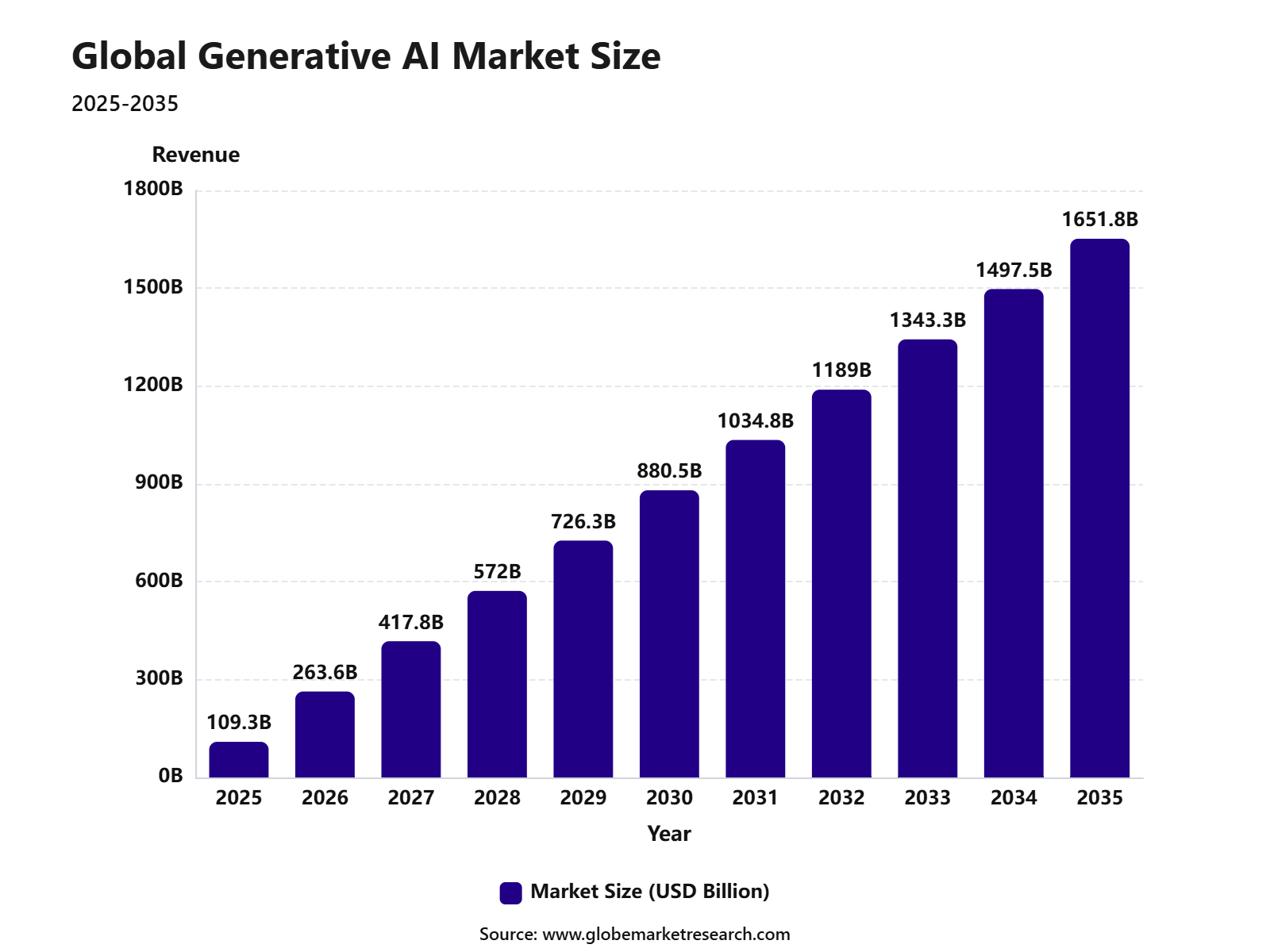 iThe graph shows projected market growth until 2035 based on CAGR analysis. Actual outcomes may vary depending on changing demand, competition, and economic factors.To gain greater insights - request a sample report PDF
Key Insight Summary
According to Globe Market Research, the Generative AI 2.0 Market was valued at USD 14.28 billion in 2026 and is projected to reach approximately USD 280.4 billion by 2035, growing at a CAGR of 39.2% from 2026 to 2035. North America accounted for around 45.2% of the market, representing approximately USD 6.5 billion in 2026.
By component, software led the Generative AI Market with a 67.1% share in 2025, supported by high adoption of AI platforms, model development tools, APIs, and enterprise-grade generative AI applications.
By technology, transformers dominated the market with a 45.9% share in 2025, driven by their strong role in large language models, text generation, coding assistants, image generation, and multimodal AI systems.
By end use, media and entertainment accounted for the largest share of 39.5% in 2025, supported by rising use of generative AI in content creation, video production, animation, gaming, advertising, and digital media workflows.
By application, natural language processing led the market with a 37.8% share in 2025, owing to strong demand for chatbots, virtual assistants, content automation, translation, summarization, and enterprise knowledge tools.
By model, large language models held the leading position with a 49.2% share in 2025, supported by rapid enterprise adoption of AI copilots, conversational AI, coding tools, and automated content generation platforms.
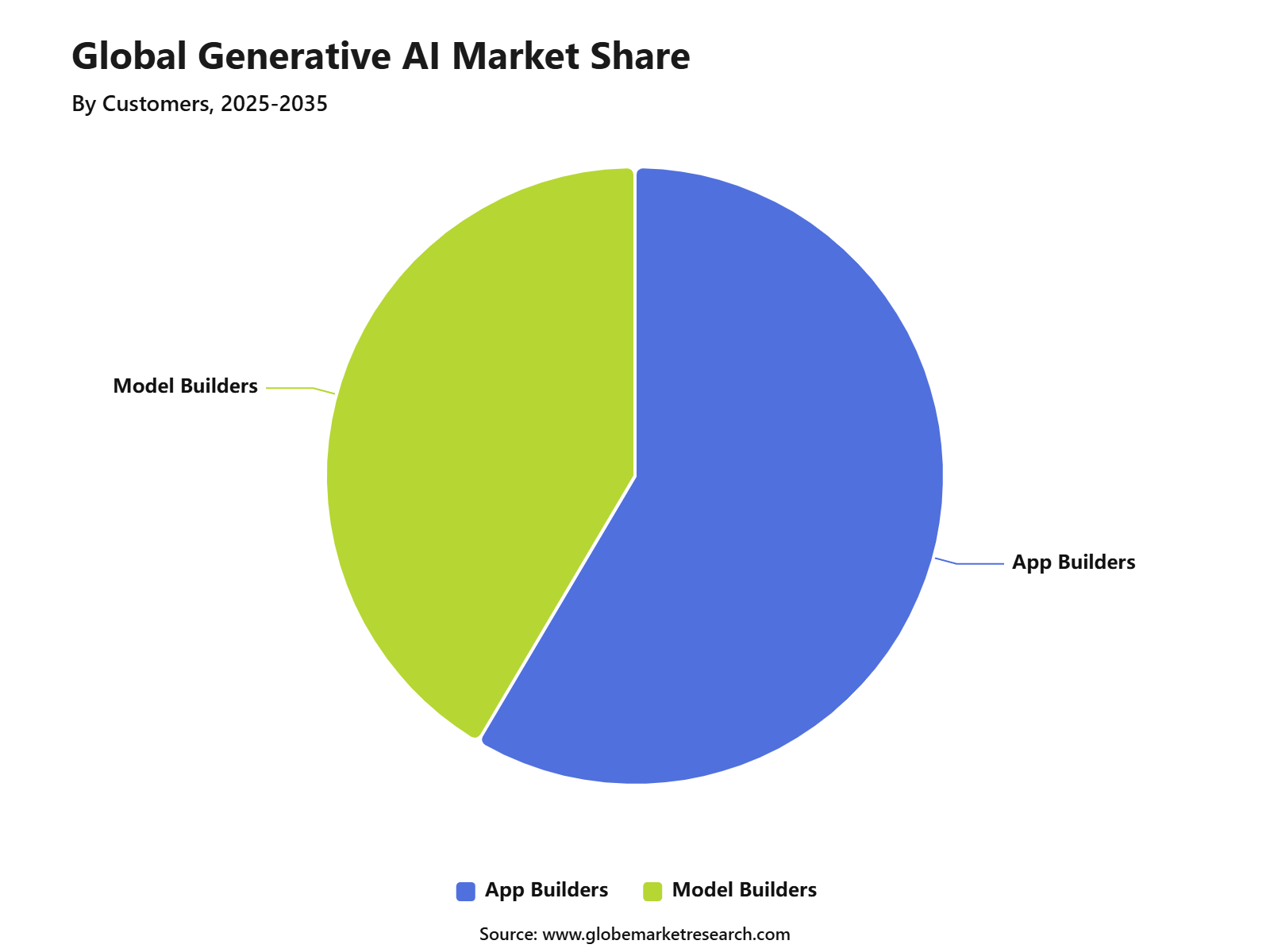
By customers, app builders dominated the market with a 58.5% share in 2025, as developers, startups, and enterprises increasingly integrated generative AI capabilities into software products, mobile apps, and business platforms.
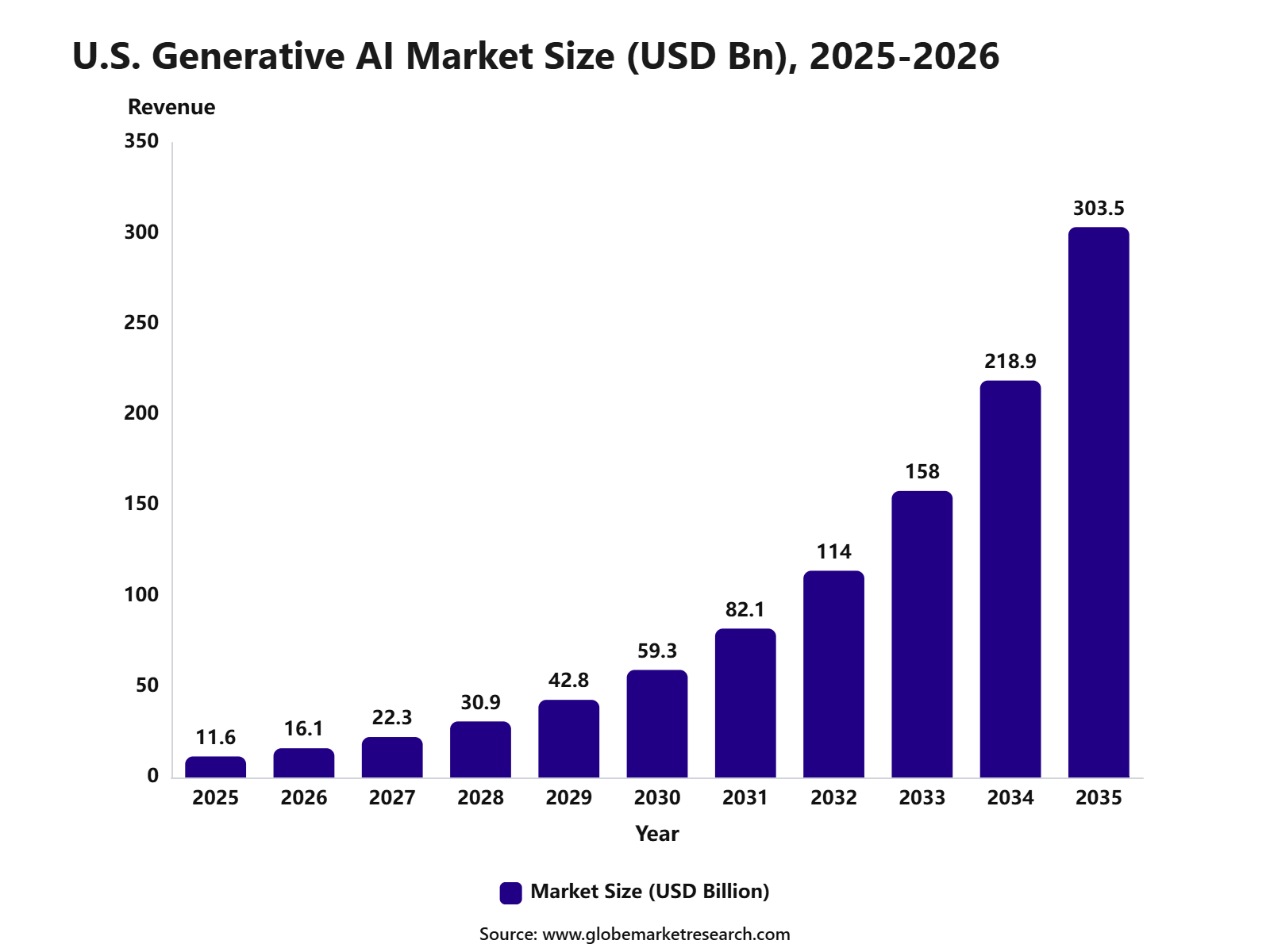
Regionally, North America led the Generative AI Market with a 49.3% share in 2025. The U.S. market was valued at USD 11.6 billion in 2025 and is projected to grow at a CAGR of 38.6%, supported by strong AI investment, advanced cloud infrastructure, enterprise adoption, and the presence of leading AI technology companies.
AI Funding & Startup Trends
Based on data from Lead with AI, Global startup investment reached a record USD 300 billion in Q1 2026, up 150% quarter over quarter. AI captured USD 242 billion, or nearly 80% of total funding, showing that capital allocation remained strongly focused on artificial intelligence companies.
Four frontier technology companies secured USD 188 billion, equal to 65% of global Q1 venture funding. This included OpenAI at USD 122 billion, Anthropic at USD 30 billion, xAI at USD 20 billion, and Waymo at USD 16 billion. Private AI companies raised USD 226 billion in Q1 2026, surpassing the full-year 2025 total of USD 217 billion in one quarter.
AI market activity also strengthened through record mega-rounds, exits, and regional investment. USD 100 million-plus rounds accounted for 94% of AI funding, while 266 AI M&A deals and 21 AI IPOs were completed in Q1 2026. U.S. and Canada venture funding reached USD 252.6 billion, with 87% going to AI, while Europe attracted USD 17.6 billion, including USD 9.2 billion for AI companies.
 iThe graph shows projected market growth until 2035 based on CAGR analysis. Actual outcomes may vary depending on changing demand, competition, and economic factors.To gain greater insights - request a sample report PDF
By Component: Software
In 2025, Software dominated the Generative AI Market with 67.1% share, supported by rising demand for AI platforms, coding tools, content generation software, workflow assistants, and enterprise automation applications. In 2026, IBM reported that only 25% of workers use AI regularly as part of their job, while 86% of CEOs believe their employees have the skills to work with AI.
The software segment is also supported by enterprise efforts to make AI part of daily work systems. IBM’s 2026 CEO study reported that 76% of surveyed organizations now have a Chief AI Officer, compared with 26% in 2025. This shows that companies are building leadership structures to scale AI software across business functions.
Segment | Share Position |
|---|---|
Software | Leading segment, 67.1% share in 2025 |
Service | Fastest-growing segment during the forecast period |
By Technology: Transformers
In 2025, Transformers accounted for 45.9% share of the Generative AI Market, driven by their strong use in text generation, translation, coding, summarisation, image-text understanding, and conversational AI. In 2026, many organizations are moving from basic generative AI use toward agentic AI systems that can coordinate tasks and complete multi-step workflows.
The segment is also supported by rising investment in AI infrastructure that can run large transformer models at scale. Reuters reported that major U.S. technology companies were expected to invest about USD 650 billion in AI in 2026, up from USD 410 billion in 2025. This investment trend supports the growth of transformer-based generative AI systems across enterprise and consumer applications.
Segment | Share Position |
|---|---|
Generative Adversarial Networks | Mature use in image synthesis and simulation |
Transformers | Leading segment, 45.9% share in 2025 |
Variational Auto-encoders | Used in pattern generation and data representation |
Diffusion Networks | High growth in image, video, and creative AI tools |
By End Use: Media and Entertainment
In 2025, Media and entertainment led the end-use segment with 39.5% share, supported by the use of generative AI in content workflows, video editing, dubbing, music support, script assistance, game design, and audience engagement. In 2026, nearly 40% of fans said they would accept AI-created content across streaming video, social media, music services, and video games if it is clearly labelled.
The segment is also supported by demand for faster content production and stronger fan engagement. In 2026, 40% of fans said they wanted one place to aggregate all their favorite fan content, while the figure rose to 49% among Gen Z and millennial fans. This creates opportunities for generative AI in content discovery, recap creation, personalised recommendations, and audience intelligence.
Segment | Share Position |
|---|---|
Media & Entertainment | Leading segment, estimated 39.5% share in 2025 |
BFSI | Fastest-growing segment, 43.2% CAGR from 2025 to 2033 |
IT & Telecommunication | Strong adoption in software development and automation |
Healthcare | Growing use in medical documentation and imaging support |
Automotive & Transportation | Used in simulation, design, and autonomous systems |
Gaming | Growing use in virtual worlds and game asset generation |
Others | Includes retail, education, manufacturing, and public sector |
By Application: Natural Language Processing
In 2025, Natural language processing held 37.8% share of the Generative AI Market, supported by strong use in chatbots, text generation, summarisation, translation, customer support, search, and document review. In 2026, 59% of consumers believed generative AI would change how they interact with companies, showing rising acceptance of AI-led communication.
The segment is also supported by business adoption of AI chatbots and language-based support tools. In 2026, 80% of companies used or planned to use AI-powered chatbots for customer service, which directly supports demand for NLP-based generative AI applications.
Segment | Share Position |
|---|---|
Computer Vision | Used in image generation, object detection, and visual automation |
Natural Language Processing | Leading segment, estimated 37.8% share in 2025 |
Robotics & Automation | Used in intelligent process automation |
Content Generation | High-growth segment across marketing and media |
Chatbots & Intelligent Virtual Assistants | Strong enterprise adoption |
Predictive Analytics | Used for forecasting and business intelligence |
Others | Includes synthetic data, design, and simulation |
By Model: Large Language Models
In 2025, Large language models captured 49.2% share of the Generative AI Market, supported by their use in conversational AI, coding support, research assistance, enterprise search, and workflow automation. The rapid rise of AI coding tools reflects this trend, as OpenAI reported that Codex adoption in India increased 27 times since January 2026.
LLMs are also being used as a base for agentic workflows and task-specific assistants. By the end of 2026, 40% of enterprise applications are expected to include task-specific AI agents, showing how LLMs are moving from simple chat interfaces into business execution systems.
Segment | Share Position |
|---|---|
Large Language Models | Leading segment, estimated 49.2% share in 2025 |
Image & Video Generative Models | Strong growth in creative AI and design tools |
Multi-modal Generative Models | Fast-growing due to text, image, audio, and video integration |
Others | Includes domain-specific and specialized generative models |
By Customers: App Builders
In 2025, App builders led the customer segment with 58.5% share, driven by rising use of generative AI APIs, coding assistants, agent-building tools, and low-code application development. In 2026, OpenAI reported that adoption of its agentic coding platform Codex in India increased 27x since January, placing India among the top five global markets for Codex adoption.
 iThe graph shows projected market growth until 2035 based on CAGR analysis. Actual outcomes may vary depending on changing demand, competition, and economic factors.To gain greater insights - request a sample report PDF
The segment is also supported by wider use of AI in software delivery and product development. In 2026, frequent users of AI coding tools were reported to deploy code daily at 45%, compared with 15% among occasional users. This shows that AI tools are becoming important for faster development cycles, although quality control and security review remain necessary.
Customer Type | Market Share |
|---|---|
App Builders | 58.5% |
Model Builders | 42.5% |
By Regional Analysis
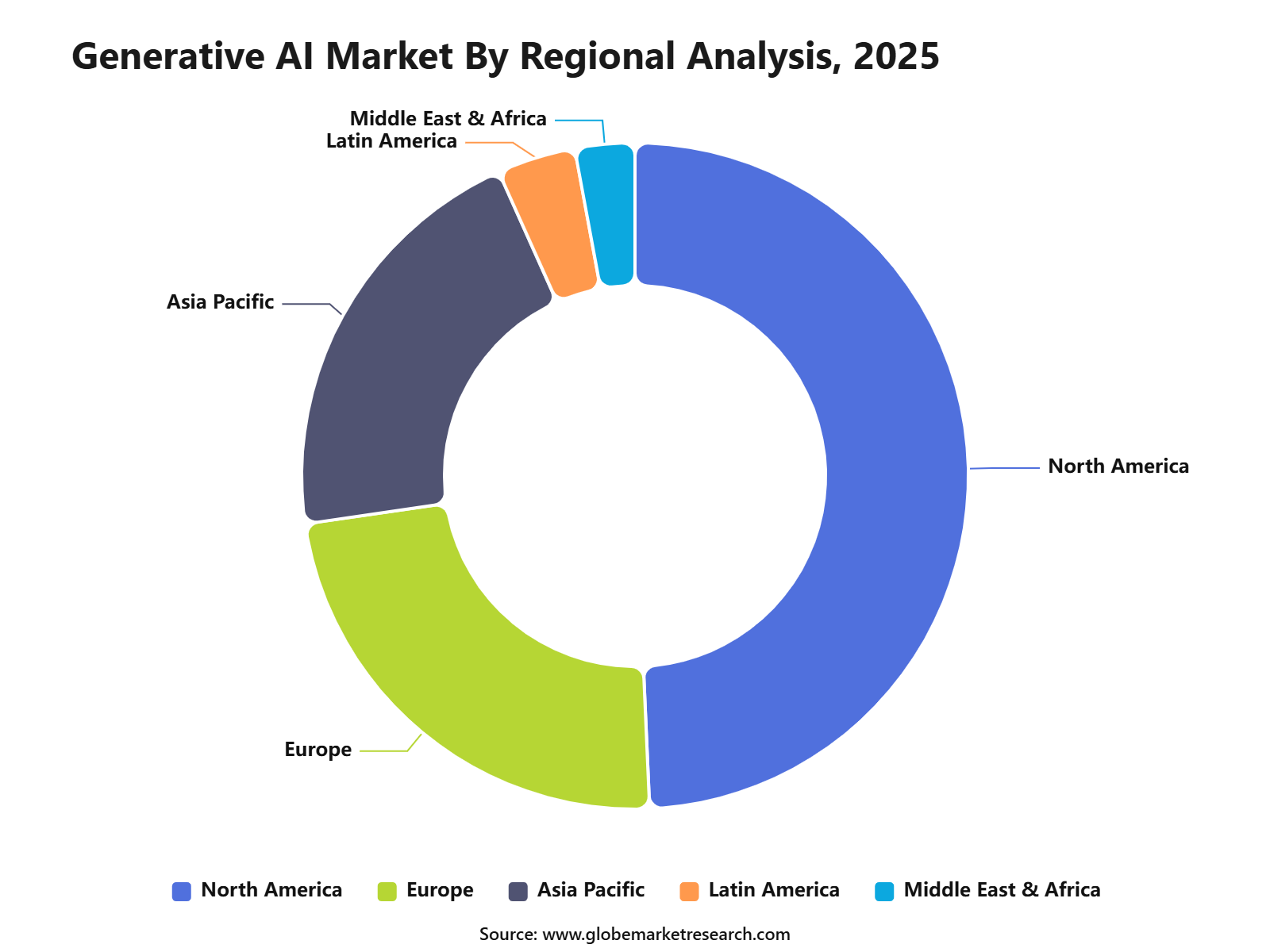
In 2025, North America held 49.3% share of the Generative AI Market, supported by strong AI investment, advanced cloud infrastructure, and early enterprise adoption. In early 2026, generative AI tools created an estimated USD 172 billion in annual value for U.S. consumers, showing the region’s strong usage base and economic relevance.
Region | Market Share |
|---|---|
North America | 49.3% |
Europe | 23.3% |
Asia Pacific | 20.1% |
Latin America | 4.4% |
Middle East & Africa | 3.6% |
 iThe graph shows projected market growth until 2035 based on CAGR analysis. Actual outcomes may vary depending on changing demand, competition, and economic factors.To gain greater insights - request a sample report PDF
The U.S. market was valued at USD 11.6 billion in 2025 and is projected to grow at a CAGR of 38.6%. In 2026, Reuters also reported that U.S. economic growth in the first quarter was supported by stronger business investment in artificial intelligence. This shows that AI spending has become an important part of technology investment and enterprise transformation in the country.
 iThe graph shows projected market growth until 2035 based on CAGR analysis. Actual outcomes may vary depending on changing demand, competition, and economic factors.To gain greater insights - request a sample report PDF
Driver Analysis
Fast Enterprise Adoption of Generative AI
The growth of the Generative AI Market is being driven by strong enterprise adoption across business functions. In 2026, AI adoption reached 88% of organizations, while generative AI was used in at least one business function by around 70% of organizations. This shows that generative AI has moved from experimental use to practical business deployment.
Demand is rising across marketing, customer support, software development, business research, content creation, and internal knowledge management. Enterprises are using generative AI to improve productivity, reduce repetitive work, and support faster decision-making. This is expected to increase demand for AI software, model integration, cloud AI platforms, and secure enterprise AI tools.
Rising Demand for AI-Ready Digital Infrastructure
The market is also supported by rapid growth in digital infrastructure and data center investment. In 2026, global electricity demand is forecast to grow strongly, with AI, data centers, and digital technologies identified as key demand contributors. The IEA expects global electricity demand to grow at an average annual rate of 3.6% from 2026 to 2030.
This trend shows that enterprises and cloud providers are expanding compute capacity to support AI workloads. Generative AI models require high-performance chips, cloud infrastructure, storage, and networking capacity. As AI workloads increase, demand is expected to rise for AI servers, GPU-based computing, cloud AI services, and energy-efficient data center solutions.
Restraint Analysis
High Compute Cost and Energy Consumption
High compute cost remains a major restraint for the Generative AI Market. AI model training and large-scale inference require advanced chips, large data centers, and continuous electricity supply. According to the IEA, traditional data centers use around 10 to 25 MW of power, while hyperscale AI centers can exceed 100 MW, which is equal to the annual electricity use of about 100,000 households.
This creates cost pressure for companies that want to deploy generative AI at scale. Smaller firms may find it difficult to manage cloud bills, model hosting costs, and infrastructure expenses. As AI usage rises in 2026, power availability, cooling needs, and compute pricing may limit adoption in cost-sensitive sectors.
Regulatory Compliance Pressure
Regulatory requirements are creating a restraint for generative AI developers and enterprise users. In the European Union, AI Act transparency rules will apply from 2 August 2026, requiring users to be informed when they interact with AI systems or are exposed to AI-generated or manipulated content.
Generative AI providers must also manage obligations related to technical documentation, copyright policies, training data summaries, transparency, risk control, and content labelling. These requirements can increase compliance costs and slow product launches. Regulated sectors such as finance, healthcare, education, legal services, and public services are expected to adopt generative AI more carefully due to governance and audit requirements.
Opportunity Analysis
Growth of AI Agents and Workflow Automation
AI agents represent a strong opportunity for the Generative AI Market in 2026. Enterprises are moving beyond basic chatbots toward tools that can complete multi-step tasks, retrieve business data, create reports, support coding, answer customer queries, and assist operations. Recent enterprise AI discussions show that many organizations are still moving from the “chat phase” toward measurable business outcomes.
This creates a large opportunity for vendors that provide secure, workflow-ready, and industry-specific AI agent platforms. Generative AI can be embedded into CRM, ERP, customer service, analytics, legal review, and software development systems. As companies focus on productivity and cost efficiency, demand for agent-based automation is expected to increase across large enterprises and mid-sized businesses.
Expansion in Consumer and Education Use Cases
Consumer and education use cases are creating new market opportunities. Stanford AI Index-related reporting for 2026 shows that generative AI adoption reached about 53% of the population within three years, while four in five university students now use generative AI tools. U.S. consumer value from generative AI tools was estimated at USD 172 billion annually by early 2026.
This adoption is increasing demand for AI writing tools, learning assistants, tutoring platforms, image generation, video creation, personal productivity tools, and coding assistants. Education platforms and consumer apps are expected to benefit from multilingual, mobile-first, and low-cost AI solutions. The opportunity is especially strong in markets where digital learning, creator tools, and self-service productivity apps are growing.
Challenge Analysis
Difficulty in Scaling from Pilot to Business Value
A key challenge for the Generative AI Market is the gap between adoption and measurable business value. Many companies are using generative AI, but implementation often remains limited to individual productivity tasks rather than full business process transformation. Recent 2026 enterprise AI analysis shows that 88% of organizations use AI, but only 39% report financial impact.
This challenge is linked to weak data readiness, limited system integration, unclear ownership, and poor governance. To generate business value, generative AI must be connected with existing workflows, internal data, security systems, and performance metrics. Without this integration, companies may struggle to justify larger AI budgets.
Reliability, Accuracy, and Risk Management Issues
Reliability remains a major challenge for generative AI in 2026. Advanced models are improving quickly, but they can still produce incorrect, biased, incomplete, or unsupported outputs. This creates risk in sensitive sectors such as healthcare, finance, law, education, recruitment, and government services.
The challenge becomes more serious as generative AI is used in autonomous agents and decision-support systems. Businesses must maintain human oversight, output validation, data protection, and model monitoring. The EU AI Act also requires stronger transparency and labelling of AI-generated content, which makes trust and risk management a core market challenge.
Top Emerging Trends
AI agents are becoming a key enterprise trend, as an average Fortune 500 company to use more than 150,000 AI agents by 2028, compared with fewer than 15 in 2025.
Agentic coding is reshaping software development, with Gartner forecasting that over 65% of engineering teams using agentic coding will treat traditional IDEs as optional by 2027.
Multimodal generative AI is gaining wider use, as Stanford HAI reported that frontier AI models now meet or exceed human baselines in areas such as PhD-level science questions, multimodal reasoning, and competition mathematics.
Consumer adoption is expanding quickly, with generative AI reaching 53% population adoption within three years, faster than the adoption pace of PCs and the internet.
Sovereign and regulated AI solutions are rising, as Capgemini’s AI-related sales pipeline exceeded USD 12 billion in 2026, supported by demand for secure and operational AI transformation.
Growth Factors
Enterprise adoption is a major growth factor, as 88% of organizations are using AI in some form, showing broad business acceptance of AI-based tools.
Generative AI is being adopted for practical business functions, with around 70% of organizations using generative AI in at least one business function in 2026.
AI infrastructure investment is accelerating, as Snowflake signed a USD 6 billion, five-year AWS deal to support generative AI, agentic AI, and enterprise AI workloads.
Data center demand is supporting AI market expansion, as AI-focused hyperscale facilities can exceed 100 MW of power requirement, reflecting the scale of compute needed for advanced models.
AI model supply is strengthening, as industry produced over 90% of notable frontier models in 2025, giving enterprises faster access to advanced generative AI capabilities.
Key Market Segments
By Component
Software
Service
By Technology
Generative Adversarial Networks
Transformers
Variational Auto-encoders
Diffusion Networks
By End Use
Media & Entertainment
BFSI
IT & Telecommunication
Healthcare
Automotive & Transportation
Gaming
Others
By Application
Computer Vision
Natural Language Processing
Robotics & Automation
Content Generation
Chatbots & Intelligent Virtual Assistants
Predictive Analytics
Others
By Model
Large Language Models
Image & Video Generative Models
Multi-modal Generative Models
Others
By Customers
Model Builders
App Builders
By Region
North America
Europe
Asia Pacific
Latin America
Middle East & Africa
Recent Developments
May 2026 – Anthropic raised USD 65 billion in Series H funding, lifting its post-money valuation to USD 965 billion. The funding will support higher computing capacity, Claude product scaling, and enterprise AI adoption. This deal shows strong investor confidence in generative AI platforms for coding, workflow automation, and business productivity.
May 2026 – SoftBank announced a major AI infrastructure investment in France. The first phase is expected to reach EUR 45 billion, with total investment potential of up to EUR 75 billion. The project aims to build large AI data center capacity, supporting demand for generative AI model training and inference workloads.
May 2026 – OpenAI Foundation committed USD 250 million to support workers, communities, and economies affected by AI disruption. The funding will support research, grants, and programs linked to AI-driven labor market changes. This move reflects rising focus on responsible deployment as generative AI adoption expands across industries.
Report Scope
Report Highlights | Details |
|---|---|
Market Revenue (2025) | USD 109.3 Bn |
Forecast Revenue (2035) | USD 1,651.8 Bn |
CAGR (2025-2035) | 31.2% |
Base Year for Estimation | 2025 |
Historic Data | 2020-2024 |
Forecast Period | 2025-2035 |
Report Coverage | Revenue projections, company positioning, competitive analysis, growth drivers, and emerging market trends |
Segments Covered | By Component (Software, Service), By Technology (Generative Adversarial Networks, Transformers, Variational Auto-encoders, Diffusion Networks), By End Use (Media & Entertainment, BFSI, IT & Telecommunication, Others), By Application (Natural Language Processing, Computer Vision, Robotics & Automation, Predictive Analytics, Others), By Model (Large Language Models, Image & Video Generative Models, Multi-modal Generative Models, Others), By Customers (Model Builders, App Builders), By Regional Insights |
Regional Analysis | North America – US, Canada; Europe – Germany, France, The UK, Spain, Italy, Russia, Netherlands, Rest of Europe; Asia Pacific – China, Japan, South Korea, India, New Zealand, Singapore, Thailand, Vietnam, Rest of Latin America; Latin America – Brazil, Mexico, Rest of Latin America; Middle East & Africa – South Africa, Saudi Arabia, UAE, Rest of MEA |
Key companies profiled | Adobe; Amazon Web Services, Inc.; D-ID; Genie AI Ltd.; Google LLC; IBM; Microsoft; MOSTLY AI Inc.; Synthesia; and More |
Customization Scope | Tailored insights for specific regions, countries, and market segments can be provided. Additional report customization is available upon request. |
Competitive Landscape
The market is characterized by intense competition among established players and emerging companies. Strategic partnerships, mergers and acquisitions, and product innovation are key strategies employed by market participants.
Key Market Players
Adobe
Microsoft
Rephrase.ai
Synthesia
MOSTLY AI Inc.
Amazon Web Services, Inc.
Genie AI Ltd.
D-ID
IBM
Other Key Players
Research Methodology
This market study is prepared using a combination of primary and secondary research. Primary research includes discussions with manufacturers, suppliers, distributors, consultants, industry experts, and end users. Secondary research covers company reports, government databases, trade associations, technical publications, regulatory sources, and trusted industry documents. The collected information is used to assess market demand, pricing trends, technology adoption, competitive activity, and regional performance.
AI language models are not used as primary data sources, and publicly available AI-generated content is not treated as market evidence. Computational tools may be used to support data processing, translation, data classification, and pattern identification. However, every published assessment is supported by verified sources, human review, and primary market discussions.
Market estimates are developed through top-down and bottom-up approaches and validated using data triangulation. Revenue, production, shipment, pricing, and application-level data are compared across multiple sources. Forecasts consider economic conditions, regulatory changes, investment activity, innovation, supply chain developments, and industry risks. All findings are reviewed through source verification and internal quality checks before publication.
Part I
Source Management & Input Data Standards
Who provides data, how sources are qualified, and what types of evidence are admissible.
Part II
Research Scope & Market Coverage
How we define the markets we assess and the parameters that govern each product.
Part III
Data Collection, Verification & Submission
The mechanics of gathering, cross-checking, and hierarchically ranking evidence.
Part IV
Assessment Determination & Quality Controls
How raw data becomes a published assessment — normalisation, expert judgement, and outlier exclusion.
Part V
Publication, Corrections & Revision
Our publication schedule, corrections policy, and methodology review cycle.
Part VI
Independence, Ethics & Complaints
Conflict-of-interest policies, editorial independence, and how clients raise concerns.
Google · Preferred Sources
Don't miss the latest market research insights and industry updates on Google.
Add Globe Market Research as a preferred source in the Google app to see our reports, analysis, and market stories in your news suggestions.
Meet the Team
This report was prepared by our expert analysts with deep industry knowledge and research experience.
Kimaya brings more than five years of experience in market research, content review, and industry analysis to Globe Market Research. She plays an important role in maintaining the accuracy, clarity, consistency, and relevance of research content across a wide range of industries. Her responsibilities include reviewing market data, segment analysis, competitive landscapes, industry trends, company developments, and strategic insights. Each report is carefully assessed to ensure that the findings are supported by reliable data, presented in a structured format, and aligned with the information needs of business decision-makers. Kimaya has research experience across healthcare, information technology, consumer goods, and several cross-industry domains.
Manoj H. is a Senior Research Analyst with more than 4 years of experience in market research, industry analysis, competitive intelligence, and strategic assessment. He has contributed to syndicated reports, customized research studies, market sizing, forecasting, company profiling, and competitive landscape analysis. His industry expertise covers Healthcare and Pharmaceuticals, Manufacturing and Construction, and Agriculture. He evaluates regulatory developments, production trends, technology adoption, supply chain structures, customer demand, investment activity, and competitive strategies across these industries.
Frequently Asked Questions
Related Reports
More in Information and Technology
Shooting Games Market Size to hit USD 238.9 bn by 2035 | CAGR of 10.7%
Shooting Games Market Insights Analysis by Product (Shooting Gallery, Light Gun Shooter, First-Person Shooter, Third-Person Shooter, and Others), by Device Type (PC/MMO, Tablet, Mobile Phone, and TV/Console), by End User (Male and Female), Regional Insights, Technology Trends, Competitive Landscape, Strategic Opportunities, and Growth Forecast, 2026-2035
AI Data Centre Cooling Market Size to Reach USD 52.2 billion by 2035
AI Data Centre Cooling Market Size, Share, Trends and Growth Analysis Report By Cooling Type (Air Cooling, Liquid Cooling, Hybrid Cooling Systems), By Data Centre Type (Hyperscale Data Centres, Colocation Data Centres, Enterprise Data Centres, Edge Data Centres), By Cooling Component (Cooling Units, Chillers, Air Handling Units, Pumps, Heat Exchangers), By End User (Cloud Service Providers, Colocation Providers, Enterprises, Government and Defense), By Regional Insights, Technology Trends, Competitive Landscape, Strategic Opportunities and Growth Forecast, 2026-2035
Agentic AI Security Market Size to hit USD 52.3 billion by 2035 | CAGR of 44.5%
Agentic AI Security Market Size, Share, Trends and Growth Analysis Report By Security Function (Identity and Access Security, AI Governance and Risk Platforms, Threat Detection and Response, Data Security and Privacy, Vulnerability Assessment and Remediation, Security Orchestration, Automation and Response, Security Posture Management, Deception Technology), By Offering (Solutions, Tools and Point Solutions, Managed Security Services, Professional and Integration Services, Training and Certification Services), By Level of Autonomy (Semi-Autonomous Systems, Fully Autonomous Security Agents), By Deployment Layer (Model Layer, Agent and Orchestration Layer, Application Layer, Data Layer, Infrastructure Layer, Integration Layer), By Deployment Mode (Cloud-Based, On-Premises, Hybrid), By Organization Size (Large Enterprises, Small and Medium Enterprises), By Application (Enterprise IT Security, Financial Services Compliance, Healthcare Data Protection, Government and Defense, Cloud Security), By Vertical (BFSI, Healthcare and Life Sciences, Government, Defense, IT and ITES, Telecommunications, Retail and E-commerce, Energy and Utilities, Manufacturing, Other Verticals), By Regional Insights, Technology Trends, Competitive Landscape, Strategic Opportunities and Growth Forecast, 2026-2035
South Korea Physical AI Market Size to Reach USD 3.6 billion by 2035
South Korea Physical AI Market Size, Share, Trends and Growth Analysis Report By Deployment (On-Device AI, Cloud-Based AI), By Component (Hardware, Software, Services), By Technology (Computer Vision, Speech and Natural Language Processing, Gesture and Movement Recognition, Reinforcement Learning and Control Systems, Other Technologies), By Robot Type (Service Robots, Humanoid and Social Robots, Collaborative Robots, Exoskeletons and Prosthetics, Mobile Robots and Drones, Industrial Robots), By Application (Healthcare, Manufacturing and Automotive, Logistics and Warehousing, Retail and Hospitality, Other Applications), By Technology Trends, Competitive Landscape, Strategic Opportunities and Growth Forecast, 2026-2035