

Revenue, 2025
$432.5Bn
Forecast, 2035
$7,268.1Bn
CAGR, 2025-2035
32.6%
Report Coverage
Global
Market Size and Forecast
2025
$432.5Bn
2035
$7,268.1Bn
CAGR
32.6%
The global AI market was valued at USD 432.5 billion in 2025 and is projected to reach USD 7,268.1 billion by 2035, growing at a CAGR of 32.6%. North America led the market with a 42.4% share in 2025, while the U.S. market reached USD 133.2 billion and is expected to grow at a 28.9% CAGR, supported by supported by strong enterprise AI adoption, advanced cloud infrastructure, and rising investment in generative AI solutions.
Key Insight Summary
Software held the largest share of the AI market with 53.4% in 2025, supported by rising demand for AI platforms, analytics tools, automation software, and enterprise applications.
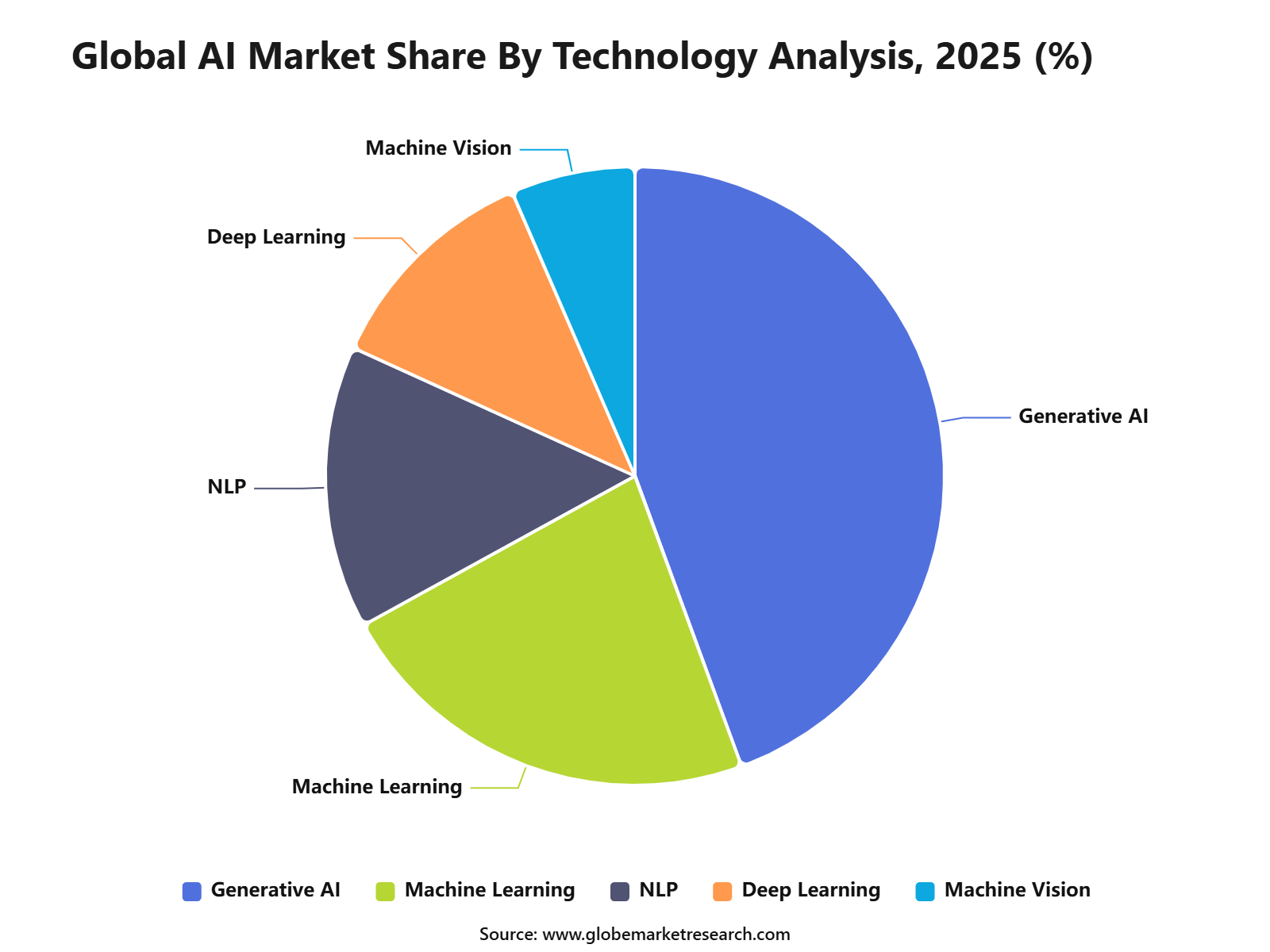
Generative AI dominated by technology with 44.4% share in 2025, driven by strong adoption across content generation, coding, customer support, research, and business productivity.
Operations led by function with 23.2% share in 2026, supported by the growing use of AI for workflow automation, process optimization, supply chain management, and decision support.
BFSI led by end-use with 22.6% share in 2025, driven by AI adoption in fraud detection, risk assessment, customer service, credit analysis, and regulatory compliance.
North America accounted for 42.4% share of the AI market, supported by strong technology investment, advanced cloud infrastructure, and early enterprise adoption.
The U.S. AI market was valued at USD 133.2 billion and is projected to expand at a CAGR of 28.9%.
AI Statistics
According to Exploding Topics, AI is expected to contribute USD 15.7 trillion to the global economy by 2030, exceeding the current combined economic output of China and India.
China is projected to record the largest AI-driven economic gain, with a 26% GDP boost by 2030, followed by North America with a 14.5% GDP boost.
China and North America together are expected to generate around USD 10.7 trillion in AI-driven economic value, accounting for nearly 70% of the total global impact.
Global AI adoption has reached 88% across organizations, showing that AI is becoming a major part of business operations.
AI expenditure in India increased by 109.6%, or around USD 665 million, in 2018.
India’s AI expenditure is projected to grow at a CAGR of 39%, reaching around USD 11,781 million by 2025.
Based on data from Digital Elevator, 66% of individuals report using AI regularly, supported by wider access to generative AI tools.
India leads generative AI adoption at 73%, compared to 45% in the U.S. and 29% in the U.K.
Around 65% of AI users are Millennials or Gen Z, showing strong adoption among younger digital users.
Nearly 4 out of 5 university students actively use generative AI tools for learning, research, writing, and productivity.
Around 88% of organizations use AI in at least one business function, mainly to improve efficiency, strengthen competitiveness, and address workforce skill gaps.
AI is expected to displace 92 million roles globally, while creating 170 million new roles, resulting in a net gain of 78 million jobs.
 iThe graph shows projected market growth until 2035 based on CAGR analysis. Actual outcomes may vary depending on changing demand, competition, and economic factors.To gain greater insights - request a sample report PDF
Segment Insights
Solution Analysis
The software segment held the biggest share of the AI market with 53.4% in 2025. Growth is supported by rising enterprise use of AI platforms, machine learning tools, automation software, analytics systems, and application-level AI features. Businesses are using AI software to improve decision-making, automate repetitive tasks, personalise customer engagement, and improve operational visibility. This makes software the most active layer of AI adoption across industries.
IBM reported that 42% of enterprise-scale companies surveyed had actively deployed AI, while another 40% were exploring or experimenting with AI. This shows that software-led AI adoption is moving from testing to wider business use. As more firms add AI into core workflows, software is expected to remain the leading solution category.
Technology Analysis
Generative AI dominated the AI market with 44.4% share in 2025. The segment is growing because it supports content creation, coding, customer support, document processing, knowledge search, product design, and business automation. Enterprises are adopting generative AI because it can improve productivity across both front-office and back-office functions. Its ability to work with text, images, code, audio, and enterprise data has increased its commercial value.
The strong position of generative AI is also supported by investment and business adoption trends. Stanford HAI reported that generative AI attracted USD 33.9 billion in global private investment in 2024, while 78% of organizations reported using AI in 2024, up from 55% in the previous year. This reflects strong demand for generative AI tools across enterprises, developers, creators, and knowledge workers.
 iThe graph shows projected market growth until 2035 based on CAGR analysis. Actual outcomes may vary depending on changing demand, competition, and economic factors.To gain greater insights - request a sample report PDF
Function Analysis
The operations segment led the AI market with 23.2% share in 2025. AI is being used in operations to improve process automation, demand planning, quality control, inventory management, workflow routing, supply chain visibility, and predictive maintenance. Companies are using AI to reduce manual work, improve speed, and support better resource allocation. This makes operations one of the most practical functions for AI deployment.
The growth of AI in operations is also linked to the need for measurable business impact. Organizations are redesigning workflows as they deploy generative AI and are putting senior leaders in key roles such as AI governance. This indicates that businesses are moving beyond isolated tools and applying AI to core operating models. As operational teams focus on cost control and efficiency, AI adoption in this function is expected to remain strong.
End-Use Analysis
The BFSI segment led the AI market by end-use with 22.6% share in 2025. Banks, insurers, and financial service providers are using AI for fraud detection, credit risk analysis, customer support, claims processing, regulatory reporting, and personalised financial services. The industry handles large volumes of data and transactions, which makes AI useful for faster analysis and risk monitoring. This supports the strong position of BFSI in AI adoption.
The segment is also driven by the need for secure, accurate, and traceable automation. AI can help financial institutions detect unusual transaction patterns, review documents, support compliance teams, and improve service response times. However, the use of AI in BFSI requires strong governance because decisions can affect customers, risk exposure, and regulatory outcomes. As a result, BFSI adoption is expected to focus on controlled AI systems with clear oversight and auditability.
Regional Analysis
North America accounted for 42.4% share of the AI market, supported by strong enterprise adoption, advanced cloud infrastructure, high AI investment, and early use of AI across major industries. The region has a strong base of technology providers, research institutions, cloud platforms, and AI-focused enterprises. This supports faster development and deployment of AI solutions across software, finance, healthcare, retail, manufacturing, and professional services.
The U.S. remains the main contributor to North America’s AI market. Stanford HAI reported that U.S. private AI investment reached USD 109.1 billion in 2024, nearly 12 times China’s investment level and 24 times the U.K.’s level. This investment strength supports model development, AI infrastructure, start-ups, enterprise software, and commercial deployment. It also explains why North America continues to hold a leading position in the global AI market.
 iThe graph shows projected market growth until 2035 based on CAGR analysis. Actual outcomes may vary depending on changing demand, competition, and economic factors.To gain greater insights - request a sample report PDF
U.S. AI Market
The U.S. AI market was valued at USD 133.2 Bn and is expected to grow at a CAGR of 28.9%, based on the provided market scope. Growth is supported by strong enterprise spending, wider generative AI adoption, cloud-based deployment, and rising use of AI in business operations. U.S. companies are using AI across customer service, cybersecurity, software development, financial services, healthcare, marketing, and supply chain operations.
The U.S. market is also supported by strong private-sector investment and advanced computing infrastructure. Stanford HAI reported that corporate AI investment reached USD 252.3 billion globally in 2024, with private investment rising 44.5% from the previous year. The U.S. remains a major centre for this investment activity due to its strong AI ecosystem and enterprise technology base.
 iThe graph shows projected market growth until 2035 based on CAGR analysis. Actual outcomes may vary depending on changing demand, competition, and economic factors.To gain greater insights - request a sample report PDF
Market Dynamics
Drivers Impact Analysis
Impact Factor | Estimated CAGR Impact | Regional Relevance | Market Impact |
|---|---|---|---|
Rising enterprise AI adoption | +7.8% | Global, North America, Europe, Asia Pacific | Expands AI use across business functions. |
Growth of generative AI applications | +7.2% | U.S., China, India, UK, Germany | Drives demand for AI platforms and tools. |
Increasing automation across industries | +6.5% | Global | Improves productivity and cost efficiency. |
Rising cloud AI deployment | +5.9% | North America, Europe, Asia Pacific | Supports scalable AI adoption. |
Growth in data generation | +5.4% | Global | Strengthens AI model development. |
Restraints Impact Analysis
Impact Factor | Estimated CAGR Impact | Regional Relevance | Market Impact |
|---|---|---|---|
Data privacy and security concerns | -4.6% | North America, Europe, developed Asia | Slows regulated industry adoption. |
High AI implementation cost | -4.1% | SMEs, emerging markets | Limits adoption by smaller firms. |
Shortage of skilled AI talent | -3.8% | Global | Delays AI project execution. |
Ethical and bias concerns | -3.4% | Global | Raises trust and governance issues. |
Regulatory uncertainty | -3.1% | U.S., Europe, China, India | Creates compliance challenges. |
Opportunities Impact Analysis
Impact Factor | Estimated CAGR Impact | Regional Relevance | Market Impact |
|---|---|---|---|
AI adoption in healthcare | +6.8% | U.S., Europe, Japan, China, India | Supports diagnosis and operations. |
AI in financial services | +6.2% | U.S., UK, Singapore, India, GCC | Improves fraud and risk management. |
AI-powered manufacturing automation | +5.7% | China, Germany, Japan, U.S., South Korea | Enhances industrial productivity. |
AI in retail and e-commerce | +5.4% | Global | Improves personalization and demand planning. |
AI infrastructure and chips | +6.5% | U.S., Taiwan, South Korea, China, Japan | Supports model training and deployment. |
Challenges Impact Analysis
Impact Factor | Estimated CAGR Impact | Regional Relevance | Market Impact |
|---|---|---|---|
AI model reliability issues | -4.0% | Global | Reduces enterprise confidence. |
Integration with legacy systems | -3.7% | Enterprises, public sector, BFSI | Delays large-scale deployment. |
Rising compute and energy demand | -3.5% | Global | Increases operating costs. |
Limited explainability | -3.2% | Regulated industries | Affects trust in AI decisions. |
Vendor lock-in risk | -2.6% | Global | Limits platform flexibility. |
Top Emerging Trends
One of the strongest trends in 2026 is the rise of agentic AI. These systems can plan tasks, connect with business software, use tools, and complete workflows with limited human direction. By 2026, around 40% of enterprise applications are expected to contain task-specific AI agents, showing that AI is moving from simple assistance to active workflow execution.
Another major trend is the growing focus on AI trust, governance, and risk management. As AI is used in finance, healthcare, legal, cybersecurity, and enterprise operations, companies are increasing controls around data privacy, accuracy, model monitoring, and human review. 2026 AI trust research found that 74% of respondents identified inaccuracy and 72% cited cybersecurity as highly relevant AI risks.
Multimodal AI is also becoming an important trend in 2026. Businesses are adopting AI tools that can process text, images, audio, video, code, and structured data in one system. This is improving use cases such as customer support, content production, medical imaging, product design, document review, and enterprise knowledge search.
Key Market Segments
By Solution
Hardware
Accelerators
Processors
Memory
Network
Software
Services
Professional Services
Managed Services
By Technology
Deep Learning
Machine Learning (ML)
Natural Language Processing (NLP)
Machine Vision
Generative AI
By Function
Cybersecurity
Finance and Accounting
Human Resource Management
Legal and Compliance
Operations
Sales and Marketing
Supply Chain Management
By End-use
Healthcare
BFSI
Law
Retail
Advertising & Media
Automotive & Transportation
Agriculture
Manufacturing
Others
Key Regions and Countries
North America
US
Canada
Europe
Germany
France
The UK
Spain
Italy
Rest of Europe
Asia Pacific
China
Japan
South Korea
India
Australia
Singapore
Rest of Asia Pacific
Latin America
Brazil
Mexico
Rest of Latin America
Middle East & Africa
South Africa
Saudi Arabia
UAE
Rest of MEA
Recent Developments
May 2026, Anthropic raised USD 65 billion in Series H funding. Its post-money valuation reached USD 965 billion, supported by strong enterprise AI demand.
March 2026, OpenAI closed USD 122 billion in committed capital. The company reached a post-money valuation of USD 852 billion to scale AI infrastructure and product development.
December 2025, Microsoft committed USD 17.5 billion in India for AI infrastructure, data centers, and cloud expansion. This built on its earlier USD 3 billion India investment.
Report Scope
Report Highlights | Details |
|---|---|
Market Revenue (2025) | USD 432.5 Bn |
Forecast Revenue (2035) | USD 7,268.1 Bn |
CAGR (2025-2035) | 32.6% |
Base Year for Estimation | 2025 |
Historic Data | 2020-2024 |
Forecast Period | 2025-2035 |
Report Coverage | AI impact analysis, Revenue projections, company positioning, competitive analysis, growth drivers, and emerging market trends |
Segments Covered | By Solution Type (Hardware, Software, Services), By Technology Analysis (Deep Learning, ML, Natural Language Processing (NLP), Machine Vision, Generative AI and Others), By Function (Cybersecurity, Finance and Accounting, Human Resource Management, Legal and Compliance, Operations, Sales and Marketing, Supply Chain Management), By End-use (Healthcare, BFSI, Law, Retail, Advertising & Media and More), By Regional Insights |
Regional Analysis | North America – US, Canada; Europe – Germany, France, The UK, Spain, Italy, Russia, Netherlands, Rest of Europe; Asia Pacific – China, Japan, South Korea, India, New Zealand, Singapore, Thailand, Vietnam, Rest of Latin America; Latin America – Brazil, Mexico, Rest of Latin America; Middle East & Africa – South Africa, Saudi Arabia, UAE, Rest of MEA |
Key companies profiled | Google, Amazon Web Services, Intel Corporation, Microsoft, IBM, Baidu Inc., NVIDIA Corporation, Lifegraph, Sensely Inc., Enlitic Inc., AiCure, HyperVerge Inc., Arm Limited, Clarifai Inc. and More |
Customization Scope | Tailored insights for specific regions, countries, and market segments can be provided. Additional report customization is available upon request. |
Competitive Landscape
The market is characterized by intense competition among established players and emerging companies. Strategic partnerships, mergers and acquisitions, and product innovation are key strategies employed by market participants.
Key Market Players
Amazon Web Services
Intel Corporation
Microsoft
Baidu Inc.
IBM
H2O.ai
NVIDIA Corporation
Enlitic Inc.
Lifegraph
Sensely Inc.
HyperVerge Inc.
Arm Limited
Clarifai Inc.
AiCure
Meet the Team
This report was prepared by our expert analysts with deep industry knowledge and research experience.
Suraj is a seasoned Senior Management Consultant with over 7 years of experience in market research, business strategy, and consulting. He has worked with Fortune 500 companies as well as emerging startups, supporting clients in cross-border expansion, market entry strategies, and growth planning. He has played a key role in delivering strategic viewpoints and actionable insights across various client projects. His expertise includes demand analysis, competitive analysis, market opportunity assessment, channel partner identification, and business expansion strategy. His analytical approach and industry understanding help clients make informed decisions and enter new markets with greater confidence.
I am a market research professional with over 7 years of experience delivering data-driven insights that support strategic decision-making. I hold a BSc in Biotechnology and an MBA in Marketing, allowing me to effectively bridge scientific understanding with business strategy. My expertise lies in analyzing complex healthcare trends, market dynamics, and competitive landscapes to help organizations identify opportunities and navigate evolving industry challenges. I am passionate about transforming research into actionable insights that drive informed growth and innovation in the sector.
Frequently Asked Questions
Related Reports
More in Information and Technology
Voice AI Agents Market to Hit USD 113.7 Billion by 2035
Global Voice AI Agents Market Size, Share Analysis Report By Solution (Voice AI Platform, Services (Professional Services(Implementation & Integration, Consulting & Training Services, Support and Maintenance Services), Managed Services)), By Deployment (Cloud Based, On Premises), By Enterprise Size (Small & Medium Enterprise Size, Large Enterprises), By Industry (BFSI, Automotive, Healthcare, Retail & E-commerce, IT & Telecom, Aerospace & Defence, Others (Utilities, Media & Entertainment)), By Regional Insights, Business plan and Project Report, Investment Opportunities, Profitability, Industry Trends, Leading Companies and Growth Forecasts by 2025-2035
AI Trust, Risk and Security Management (AI TRiSM) Market to hit USD 39.8 Bn by 2026
Global AI Trust, Risk and Security Management (AI TRiSM) Market Size, Share Analysis Report By Component (Solutions, Services), By Technology (ML based TRiSM, Natural Language Processing based TRiSM, Explainable AI (XAI), Federated Learning/Privacy-Preserving ML), By Application (Model Governance & Compliance, Model Monitoring & Observability, Data Privacy & Security, Bias Detection & Mitigation, Identity & Access Security for AI), By Deployment (On-premises, Cloud), By Organization Size (Large Enterprises, Small & Medium Enterprises), By Industry Vertical (BFSI, Healthcare, Retail & E-commerce, IT & Telecom, Government & Defense, Manufacturing, Transportation & Logistics), By Regional Insights, Business plan and Project Report, Investment Opportunities, Profitability, Industry Trends, Leading Companies and Growth Forecasts by 2025-2035
K-12 Education Technology (EdTech) Market to hit USD 491.5 Bn by 2035
Global K-12 Education Technology (EdTech) Market Size, Share Analysis Report By Component (Hardware, Software, Services), By Deployment Mode (Cloud-Based, On-Premises), By Technology Type (Learning Management Systems (LMS), Student Information Systems (SIS), Gamification & Game-based Learning, AR/VR in Education, AI-enabled Learning Tools, Adaptive & Personalized Learning, eContent & Digital Courseware), By Application (Classroom Learning, Remote Learning / Online Learning, Curriculum Management, Content Delivery & Digital Textbooks and Others), By End User (Public K-12 Schools, Private K-12 Schools, Charter Schools, Home Schools), By Regional Insights, Business plan and Project Report, Investment Opportunities, Profitability, Industry Trends, Leading Companies and Growth Forecasts by 2025-2035
US Esports Market to hit USD 29.3 Bn by 2035
US Esports Market Size, Share Analysis Report By Revenue Source (Advertising & Sponsorships, Media Rights, Merchandise & Tickets, Others), By Platform (PC Gaming Platforms, Console Gaming Platforms, Mobile & Tablet Platforms, Others), By Game Genre (MOBA Games, First-Person Shooter Games, Battle Royale Games, and Others), By Streaming Type (Live Streaming, On-Demand Streaming, Hybrid Streaming), By Device Type (Smartphones, PC, Console, Others), By End User (Advertisers & Sponsors, Game Publishers, Streaming Platforms, Tournament Organizers, Teams & Players, Viewers/Fans), By Regional Insights, Business plan and Project Report, Investment Opportunities, Profitability, Industry Trends, Leading Companies and Growth Forecasts by 2025-2035